
Monica Mottin
Dr. Monica Mottin is a social anthropologist whose work examines performance, ritual, and heritage-making, with a particular focus on theatre for social change and religious performance in Nepal.
Performance, Ritual, and Heritage as Placemaking in Janakpurdham, Nepal
This research examines performance and performativity as key mechanisms of political, social, and sacred placemaking in Nepal. Initial work focused on street theatre as a tool for political and social change in Kathmandu and the Deukhuri Valley (Dang district), tracing how performance operates as a form of collective action and social intervention. These inquiries were informed by transnational activist platforms such as the European Social Forum and the Asian Social Forum and culminated in an ethnographic analysis of development projects that deploy theatre to address social issues. The resulting study explored the theoretical interplay between performance and social life and was consolidated in Rehearsing for Life: Theatre for Social Change in Nepal (Cambridge University Press, 2018).
Within the framework of the Heritage as Placemaking project (2021–2025) at the Heidelberg Centre for Transcultural Studies, Heidelberg University, the research expanded from the political into the sacred. It examined how religious performances staged during festivals such as Dashain and Vivah Panchami actively construct Janakpurdham as a sacred city. The analysis revealed multiple, overlapping sacred geographies that are activated at different moments in the annual ritual cycle. Repeated bi-annual field visits demonstrated that the city and its rural hinterland form a connected cultural landscape rather than discrete entities, and that understanding both is essential for grasping how religious performances construct places and are collectivized and recognized as “heritage.”
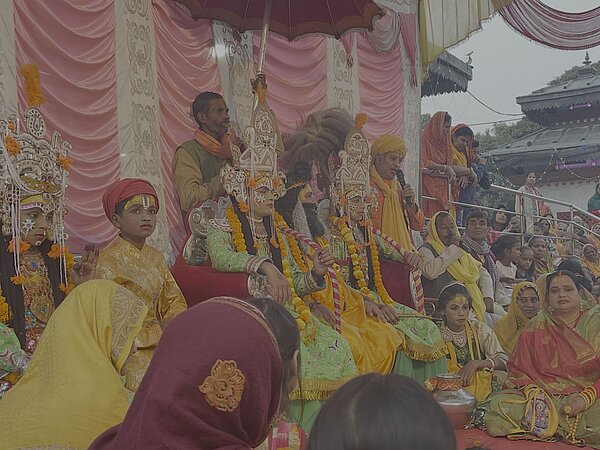
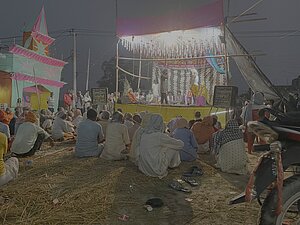
Ethnographic research in the urban context—engaging with cultural activists, theatre groups, temple mahants (chief priests), youth clubs, and artists who return annually to perform—proved methodologically straightforward. In contrast, documenting folk performances such as nach and nautanki posed significant challenges. Centered on epics and the enactment of stories of folk deities and heroes, these folk dramas are staged at the margins of visibility as part of entertainment organized in rural melas (fairs). They are performed for eight to ten hours without pause over consecutive nights by folk artists, largely from Dalit communities, who trace their practice through ancestral lineages.
These performances are often regarded by younger generations as relics of the past and are primarily appreciated by older audiences. Existing outside structured public calendars, they are not advertised on social media, rarely discussed in the city, and are frequently replaced by more “modern” dance forms intended to attract younger spectators. This marginal status made the performances exceptionally difficult to locate and document.
A methodological breakthrough emerged through a shift in focus from performance alone to the broader “festival ecosystem.” Extended stays in villages and participant observation revealed that festivals involve the construction of clay murtis (deities) and tableaux representing gods and goddesses such as Durga, Lakshmi, Santoshi, Salhesh, and Hanuman for ritual purposes. Collaboration with village-based murti constructors demonstrated how tangible and intangible elements of ritual life are mutually constitutive and inseparable. By tracing the creation and circulation of these sacred objects, the research mapped festival networks and performance itineraries.
This strategy of “following the gods” made it possible to locate and document otherwise elusive folk dramas and revealed the cross-border mobility of performers themselves. Material culture thus emerged as a crucial methodological key for understanding intangible performance practices, highlighting the entanglement of objects, movement, and embodied knowledge across the Nepal–India border.
While the progressive construction of Janakpurdham’s sacred geographies as heritage forms the focus of the forthcoming monograph The Temple and the Stage: Religious Heritage, Invisible Placemaking and Performance in Janakpurdham (Springer), ongoing research continues to investigate epic traditions and the lived experiences of folk drama artists whose practices traverse national boundaries.


 Datenschutz Impressum