Binita Magaiya
Conservation architect Binita Magaiya specializes in preserving neglected ruins by prioritizing community engagement. Her work on the "Heritage as Placemaking" project, focusing on Mukunda Sen Palace (Gaidakot), Mukundeshwori temple (Muchuck, Bandipur), and Brahma temple (Kathmandu), examined how local populations interact with heritage restoration.
Reframing Heritage Value: Community Engagement, Religion, and the Vulnerability of Ruins in Nepal
The research investigates how local populations interact with heritage restoration efforts and argues that heritage value is rooted not in static materiality but in human perception. This value is transmitted across generations through sites, materials, and living traditions. The project defines the characteristics of heritage and community creation by identifying key actors, strategies, and processes involved in successful revitalization efforts. It emphasizes the potential of religion and heritage to function as intertwined forces in fostering community identity, while also critically examining the risks this relationship poses. Central to the inquiry is the tension between authenticity and conjectural reconstruction, particularly where reconstruction is driven by community identity needs rather than archaeological evidence. The research also interrogates how modernization—from new materials to infrastructural changes—affects a site’s historicity and legibility.
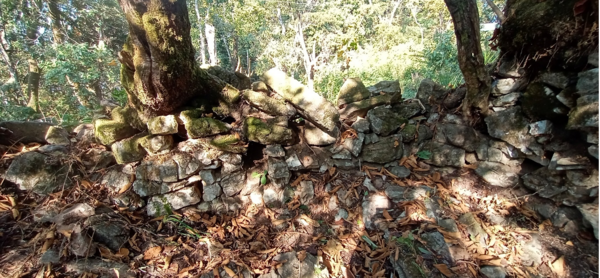
A core argument advanced by the research is that all heritage structures are inherently vulnerable to physical erasure, decay, or conceptual obsolescence without immediate, comprehensive, and meaningful community involvement. This vulnerability is particularly acute in the Nepali context, where the interpretation of ruins is often shaped more by religious resonance than by historical or archaeological significance. In many cases, material remains are perceived primarily as sacred spaces rather than as historical documents.
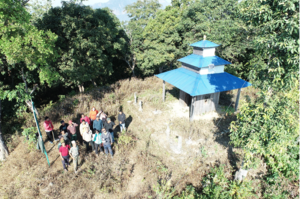
The Mukunda Sen Palace in Gaidakot exemplifies these challenges. Its Sen-period history has been overshadowed by a dominant nationalistic narrative, and recent developments demonstrate how local agency can override centralized conservation authority. The unauthorized construction of a temporary Siddheswori temple directly on the palace ruins illustrates a community’s prioritization of immediate spiritual and social needs, frequently in disregard of the Department of Archaeology (DoA). While such religious associations may protect sites from abandonment, the research cautions that they can also lead to modifications, reconstructions, or re-purposing that obscure or erase original historical fabric.
Across the case studies, the research posits that heritage value is not an objective or static quality but a cultural legacy continually produced and reproduced through interaction. Heritage and community creation are understood as ongoing, mutually constitutive processes. Within this framework, the research explores how cultural heritage can actively support and enhance community resilience in the face of modernization and change. However, findings also indicate that when religious association becomes the primary or sole draw of a site, its long-term historical viability is often jeopardized. The sacred status may protect it from neglect, but it can also lead to modifications, reconstructions, or re-purposing that obscure or erase the original historical fabric.
The research critically engages complex theoretical issues, including identifying the key actors, strategies, and processes that define successful heritage and community creation efforts.
* The Role of Religion: Emphasizing the powerful potential for both religion and heritage to serve as twin engines for fostering a strong and cohesive community identity.
* Conjectural Reconstruction and Authenticity: A critical examination of "authenticity" in the context of reconstruction projects that are driven not by archaeological evidence but by the needs and desires of a community's identity. Magaiya questions the historical validity of such efforts.
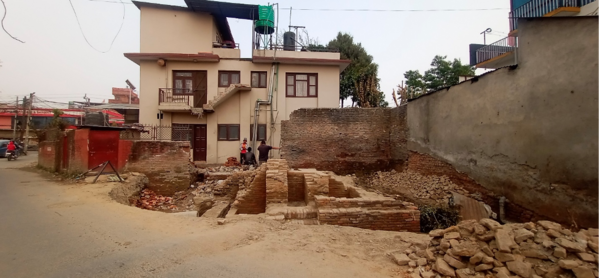
* Modernization and Historicity: Analyzing how the pressures and processes of modernization—from new building materials to altered access routes—impact a site's original historicity and legibility.
Overall, the research advances a critical shift in conservation thinking: moving away from top-down, expert-driven models toward bottom-up, community-stewarded paradigms. By foregrounding local engagement while interrogating authenticity, authority, and modernization, the project offers a nuanced roadmap for reimagining heritage conservation as an active process of placemaking rather than mere material preservation.


 Datenschutz Impressum