

Courtyards and alleyways of Patan (northwest)
Curated by Manik Bajracharya 2022
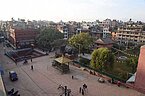
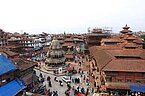
The Walk begins at the western entry point of Patan, with a Gaṇeśa Temple built before 1683, and ends at the Darbar Square. One of the attractions of the Walk is Chāyabāhāḥ Maṭha, a Śaiva ascetic monastery built before the 18th-century which is one of the five maṭhas in Patan belonging to the Śaṅkarācārya tradition. It also covers four of the major monasteries of the Newar Vajrayana tradition, three Heritage Focus Areas and several shrines and religious objects such as caityas and maṇḍalas.
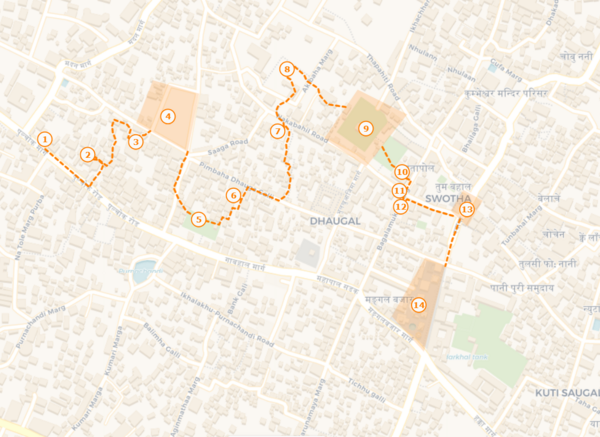
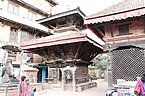
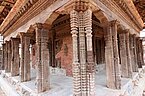
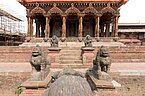
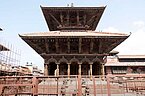
Stations of the Walk
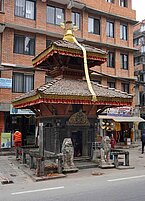
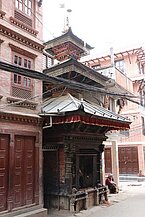
1 - Gaṇeśa Mandira (built before 1683 CE) || गणेश मन्दिर:
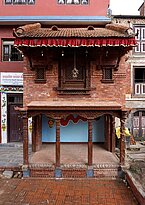
This small pagoda-style temple of Gaṇeśa is located at Naḥtvāḥ which is the western entry point to the historic city of Patan. It features a four-armed stone statue of Gaṇeśa. There is a medieval waterspout (hiti in Newari) right next to the temple. A socio-religious organization (guthi) belonging to the Jyāpu community is associated with this temple. An additional Gaṇeśa image is displayed here on the day of the Indrajātrā, followed by distribution of ritual food called samaybaji. There is a three-bay phalcā right in front of the temple.
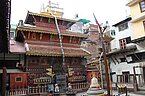
2 - Si Bāhāḥ (mid-14th cent. CE) || सि बाहा:
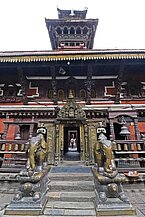
Si Bāhāḥ, also known as Śrīvaccha Mahāvihara, is one of the eighteen major traditional Buddhist monasteries of Patan. The triple roofed main shrine of this monastic compound consists of four floors and houses an image of standing Buddha in a posture called bhaviṣyavyākaraṇa-mūdrā. Epigraphic evidence of this monastery goes back to 1389.
3 - Chāya Bāhāḥ Maṭha:
One of the unique monuments at the Pimbāhāḥ Heritage Focus Area is this Śaiva ascetic monastery called Chāya Bāhāḥ Maṭha. It is among the five maṭhas in Patan and is believed to be established by certain Jayakiśora Bhāratī coming from India not later than the 18th century. This maṭha, belonging to the tradition of Śaṅkarācārya, is built in Newari architectural style.
4 - Pimbāhāḥ Heritage Focus Area:
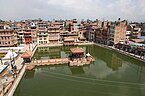
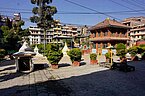
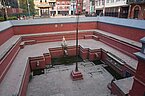
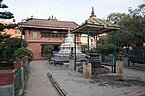
Pimbāhāḥ is a unique part of Patan’s urban heritage and dynamic life, with a high condensation of sites used for social, religious, economic and cultural purposes. The area consists of 12 rest houses (phalcās) and six other monuments. One of the ancient water tanks in Patan that has survived so far is here. To the west of the water tank lies a set of five caityas collectively known as Cilaṃdyaḥ. An inscription here mentions of its reconstruction after it was destroyed in an invasion by Sultan Shamsuddin in the 14th century. It is considered to be built by the Mauryan Emperor Aśoka.
5 - Bu Bāhāḥ (before 1098 CE) || बु बाहा:
The Buddhist monastery Bu Bāhāḥ, also known as Yaśodhara Mahāvihāra comprises of the monastic community with biggest number of Vajrācārya priests in Patan. Bū Bāhāḥ also boasts one of the largest Buddhist courtyards in Patan, measuring 60m from east to west and 34m from north to south. The Bāhāḥ is located near the crossroad of the Pulcok-Mangal Bazar road and the street that leads from Pimbāhāḥ pond to Pūrṇacaṇḍī. The monastic compound features a main monastic building (kvāpādegaḥ) enshrining an image of Buddha Akṣobhya, a separate building (digi) for esoteric rituals, and numerous caityas and other artifacts. Even though epigraphic evidence of its establishment cannot be found, it is mentioned in a manuscript dated 1098 CE.
6 - Bhailaḥsĩ Bāhāḥ (1896 CE) || भैल:सिं बाहा:
Named after its founder, Bhairavasiṃha Vajrācārya and established in 1896, Bhailaḥsĩ Bāhāḥ is a privately organised shrine. It is also considered a branch of Bu Bāhāḥ. It can be reached walking through narrow alleyways from the northeastern corner of the courtyard of Bu Bāhāḥ. The shrine, consisting of four floors and an image of Akṣobhya, is built alongside private houses.
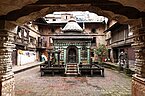
7 - Naka Bahī (before 1658 CE) || नक बही:
If one walks further from Bhailaḥsĩ Bāhāḥ through the alleyways towards north, he will first reach the street of Dhaugaḥ and then to Naka Bahī. Also known as Lokakīrti Mahavihāra, it is one of the fifteen major bahī-type monasteries of Patan. In contrast to a bāhāḥ, a bahī form of Newar Buddhist monasteries is believed to be resided originally by celibate monks. Naka Bahī is a two-storeyed building with traditional quadrangular shape built around a courtyard measuring circa 13 meters on each side. The north-facing main shrine houses an image of the Buddha Akṣobhya.
8 - Nyākhā Cuka || न्याखा चुकी:
Nyākhyā Cuka is a large residential courtyard. An inscription dating 1719 CE installed in nearby Kvāḥ Bāhāḥ refers to Nyākhā Cuka as Bhāskaravarṇa Mahāvihāra which attests the fact that it probably used to be a functioning monastery. Currently, the courtyard has numerous Buddhist votive objects (caityas and elevated maṇḍalas) and deities including Lokeśvaras, Gaṇeśa, Saraśvatī and Akṣobhya. A large Buddha statue has additionally been installed recently.
9 - Nāga Bāhāḥ Heritage Focus Area:
NNāga Bāhāḥ is another large residential courtyard adjacent to Nyākhā Cuka. In spite of its name as a Bāhāḥ the current structure of the courtyard has no monastic building. Largely Buddhists, the residents of this area include artisans and traders. The heritage area of Nāga Bāhāḥ consists of a Licchavi-period water spout, a temple of Saṃkaṭā, two rest houses, and a small free-standing structure called Khāchẽ Bāhāḥ. The place is also known as Itilhane or Yitilhane. There are two adjacent courtyards named Ilānani and Sarasvati Nani (LAL0108) to it. According to John K Locke, references to this Buddhist compound can be found as early as the 15th century.
10 - Hiranyavarṇa Mahāvihāra (Kvā Bāhāḥ, aka Golden Temple):
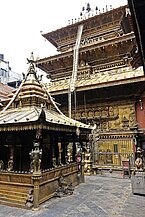
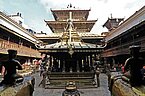
Hiraṇyavarṇa Mahāvihāra is the most active and arguably the most important of Patan’s Buddhist monasteries. The monastic building and courtyard still retain the original structure of a traditional Buddhist monastery. The entire compound is richly decorated and the house containing the main shrine is covered with gilt metal panels. The courtyard is filled with numerous artifacts such as a smaller structure enshrining a silver caitya, the Lokeśvara images at its four corners and several other artifacts. The main exoteric deity of the monastery is the Buddha Akṣobhya. Other sections of the Bāhāḥ include shrines dedicated to deities Tārā, Nāmasaṅgīti, Vairocana, Amoghapāśa Lokeśvara and so on. Like every other bāhāḥ, it also has esoteric sections accessible by initiated members. The monastery strictly observes daily rituals and other regular activities. Recitation of the Prajñāpāramitā scripture is recited daily. It has by far the largest monastic community (called saṅgha) of any Bāhāḥ in Patan.
11 - Kvālkhu Gaṇeśa Mandira || क्वाल्खु गणेश मन्दिर:
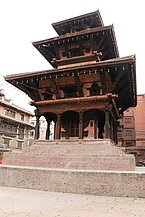
Immediate south of the entrance of Hiraṇyavarṇa Mahāvihāra lies the crossroad of Kvālkhu. This place has a three-tiered Kvālkhu Gaṇeśa Temple (LAL1120), a multipurpose small building associated with the shrine, the rest house called Kvālkhu Gaṇeśa Sataḥ (LAL4186) and the Umāmaheśvara Temple (LAL1130). The Kvālkhu crossroad is also associated with a legend on how Kirātīs were chased away by the powers of the enshrined deity at Hiraṇyavarṇa Mahāvihāra.
12 - Umāmaheśvara Mandira at Kvālkhu (1803 CE) || उमामहेश्वर मन्दिर:
The Umāmaheśvara Temple is located in the Kvālkhu Square. It has a two-tiered roof. The temple is part of the Patan Darbar Monument Zone, a UNESCO World Heritage Site.
13 - Svatha Square:
Heading east of the crossroad of Kvālkhu, one reaches Svatha Square. The square is home to the Rādhākṛṣṇa Temple (LAL1390) originally built in 1668, the Svathanārāyaṇa Temple (LAL1410), and the śikhara-styled stone temple of Kṛṣṇa (LAL1400). The square has become well-known among tourists due to its monuments, its close vicinity to the Patan Darbar Square and the home-stay facilities offered by local residents.
14 - Heritage Focus Area - Patan Durbar Square:
Patan Darbar Square is the heart of the old town of Lalitpur and one of three royal squares in the Kathmandu Valley, all of which are declared UNESCO World Heritage Sites. One of its attractions is the ancient Royal Palace where the Malla Kings of Lalitpur resided. NHDP has documented many previously undocumented monuments located at this Square. The Darbar Square consists of major monuments such as the Krṣṇa Temple (LAL1341), Bhīmasena Temple (LAL1380 ), Viśvanātha Temple, Viśveśvara Temples, Cāranārāyaṇa Temple, Taleju and beautiful courtyards such as Keśavanārāyaṇa Coka, Mūla Coka and Sundarī Coka.


 Datenschutz Impressum