

Kirtipur Heritage Walk
Curated by Bharat Maharjan
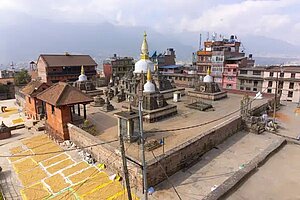
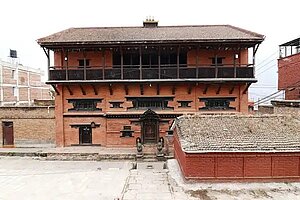
Kirtipur, one of the lagest Newar settlements of the Kathmandu Valley is believed to be founded by King Sadāśivadeva at the turn of the 11th-12th century CE. Local residents of this ancient city have engaged in preserving and recharging the tangible and intangible heritage sites and practices that have partly been included in the World Heritage List Nominations by the UNESCO. With its numerous temples, stūpas, caityas and arcaded platforms (phalcās), the life in Kirtipur’s historic city is made up of several impressive processions, festivals and other cultural activities throughout the year. We have curated a route that shows the rich heritage of Kirtipur, featuring some of its unique monuments located in the eastern part of the city
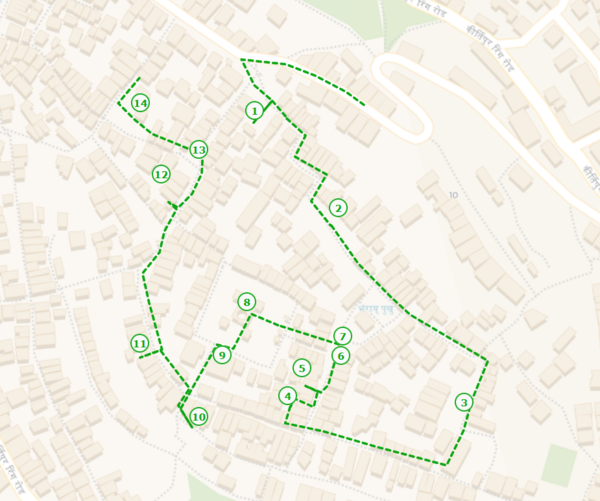
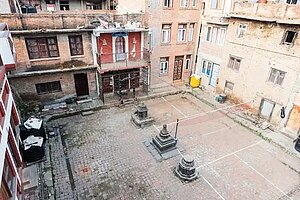
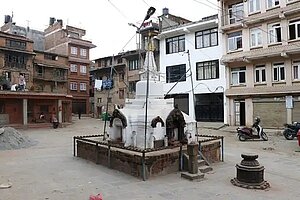
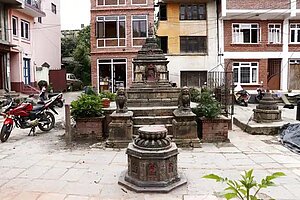
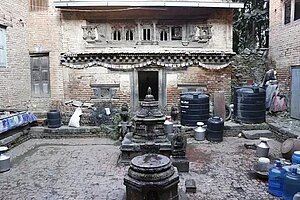
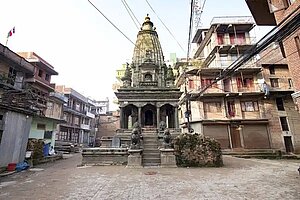
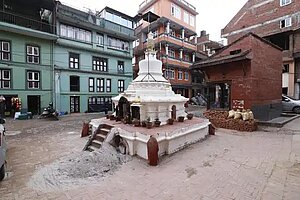
Stations of the Walk
1 - Cīthū Bahī || चीथू बही:
This monastic building is part of one of the largest Buddhist neighborhoods in Kirtipur. The place is also known under its Sanskrit name, Padmakīrtigīri Mahāvihāra. Though there are no records of the initial construction, an inscription from 1659 CE (NS 779) refers to Cīthū Bahī as a monastery (Kittipura, corr. Kīrtipura Vihāra and Kīrtipuri Vihāla). At that time, it was particularly housing the sacrificial fire (agniśālā). Land endowed to Cīṭhū Bahī was appropriated by the government in 1956 CE to establish the Tribhuvan University. In 2014, members of the Kirtipur Śākya community joined to rebuild the shrine (dyaḥchẽ) building. A new statue of Maitriya has been replaced in the sanctum.
2 - Taḥnani Caitya || त:ननि चैत्य:
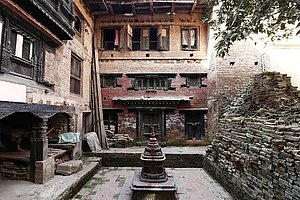
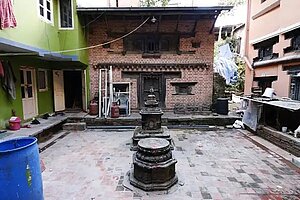
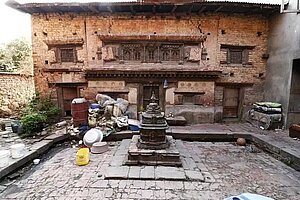
Taḥnani Caitya stands at the centre of a large residential courtyard called Taḥnani, north of the Cilancva Caitya premises (KIR0001). The Caitya’s plinth has six inscriptions, the oldest dating back to 1665 CE (NS 785). An inscription that is not at the place any more, dated back to 1630 CE (NS 750) records the donation of a golden parasol, as well as the renovation of the Caitya, and the addition of niches (gavākṣa) for the statues of the Dhyānī Buddhas. Tahnani courtyard is home to a very active musical practice of devotional music (dapha khalaḥ) across the site and sometimes the whole historic city (see the heritage walk by Pushpa Palanchoke).
3 - Mātakhyaḥ Śikharakūṭa Caitya || मातख्य: शिखरकूट चैत्य:
This Caitya is situated at the rectangular courtyard of the Mātakhyaḥ ṭola, close to the eastern border of Kirtipur. The shrine houses four Lokeśvara, one on each side of its main body: Maitreya (east), Vajrapāṇi (south), Padmapāṇi (west) and Mañjuśrī (north). The Caitya is also worshipped during the annual procession of the Buddhist monuments in Kirtipur in memory of those who died within that year. In the night of Gunpunhī and the following morning, family members of the deceased walk the city, accompanying a priest.
4 - Kvay Bāhāḥ (1701 CE) || क्वय् बाहा:
Constructed in 1701 CE (NS 821), Kvay Bāhāḥ is another monastic branch of Cilancva Bāhāḥ (KIR0002). On the tenth day of the Dashain festival in autumn, a tantric ritual is performed inside the monastery’s prayer room (āgaṃ) where the secret deity is housed. Following this ritual, upon exiting the deity’s house (dyaḥchẽ) and still on the premises of the monastery, some ritual performers sacrifice an orange color pumpkin with a sword (khaḍga). This ritual, usually conducted only in the abodes (pīṭha) of the Goddesses, is quite unique.
5 - Cvay Bāhāḥ (probably built in 1642 CE) || च्वय् बाहा:
Cvay Bāhāḥ (Harṣakīrti Mahāvihāra) is one of the monastic branches of the Cilancva Bāhāḥ (KIR0002). The oldest inscription installed here dates from 1642 CE (NS 762) and mentions that a person called Hākuju installed a Śākyamuni Buddha statue as well as a caitya. In the course of time, following the completion of the monastery, the statue was consecrated as the Bāhāḥ’s principle deity. The statue was replaced later by the present-day Akṣobhya statue.
6 - Buddha Mandira (1649 CE) || बुद्ध मन्दिर:
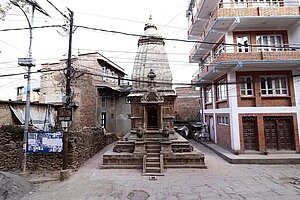
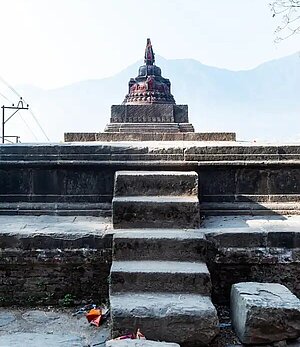
Buddha Mandir, built in 1649 CE, is a rare example of a śikhara-styled Buddhist stone temple in Kirtipur, in the memory of the donor’s parents. When the initial construction of this temple was completed, the pinnacle (gajū) was mounted on top of the temple’s roof and a statue of Śākyamuni was installed in its sanctum. This was followed by a fire sacrifice.
7 - Lokeśvara Mandira (1684 CE) || लोकेश्वर मन्दिर:
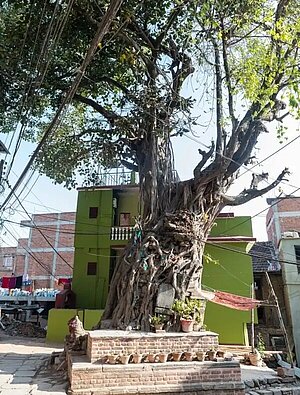
This Lokeśvara temple was built in 1684 CE (NS 804). It is another rare Śikhara-styled Buddhist temples in the Kathmandu Valley. What makes it additionally interesting is its symbiosis with a Bodhi tree. This has not kept people from worshipping the temple.
8 - Cilancva Caitya (1515 CE) || चिलन्च्व चैत्य:
Cilancva Caitya is situated at the highest point in the eastern part of Kirtipur and is believed to be constructed by the Maurya Emperor Aśoka. The Caitya is the oldest and largest of its kind in Kirtipur. An inscription recording the initial construction of this monument in 1515 CE (635 NS) is attached to the Caitya’s plinth. It also describes different stages of the construction process and praises. Jagatapāla, a representative of the local political elite (Mahāpātra) from Patan, commissioned this Caitya.
9 - Cilancva Bāhāḥ (ca. 1515 CE) || चिलन्च्व बाह:
This monastery was constructed in 1515 CE and is listed as one of the larger Buddhist monasteries, or Mahāvihāras, Kingdom of Patan. It is run by a spiritual brotherhood (saṅgha) consisting of members from the Śākya and Vajrācārya clans. Each Vajrācārya member is responsible for carrying out the daily worship for two weeks throughout the year. The ritual worship is followed by devotional music called gambāḥsĩ, which is a unique feature of monasteries in the valley.
10 - Majāḥdegaḥ || मजा:देग:
This Caitya stands on a steep slope to the south of the Cilancva Bāhāḥ (KIR0001). It is built on top of a four-layered stone plinth. Compared to other caityas in Kirtipur, the plinths of the Majāḥdegaḥ are larger in size. There is no evidence to date the initial construction of this monument. However, the motifs that are carved on this Caitya suggest that it was possibly built between the seventeenth and eighteenth century.
11 - Kusi Bāhāḥ (ca. 17th-18th Cen.) || कुसि बाहा:
Kusi Bāhāḥ is also part of the network of monasteries related to Cilancva Bāhāḥ’s. Its date of construction is unknown but the woodcarvings on the deity’s house (dyaḥchẽ) can be dated back to the seventeenth and eighteenth century. A Vajrācārya family resides in front of the monastery and members of the brotherhood (saṅgha) of the Cilancva Bāhāḥ (KIR0002) are responsible for maintaining it and carrying out the rituals.
12 - Yākaḥ Bāhāḥ (1647 CE) || याकः बाहाः
This branch of the Cilancva Bāhāḥ (KIR0002), called Yāka Bāhāḥ, was built in 1647 CE. An inscription from 1680 CE (801 NS), installed on themonasterie’s premises, attests that it was built by a Vajrācārya family. It also mentions that King Siddhinarasiṃha Malla was present during the inaugural ceremony, which attests the importance of the building.
13 - Lvaṃha Degaḥ (1664 CE) || ल्वहं देग:
The Lvaṃha Degaḥ temple is another rare example of Buddhist Śikhara temple architecture in the Kathmandu Valley. According to an inscription on the middle plinth of the temple, the initial construction was started in 1663 CE (784 NS). Here too, King Śrīnivāsa Malla attended the inauguration and consecration ceremony.
14 - Gutpau Caitya || गुत्पाै चैत्य ll:
This Caitya holds a statue of an Akṣobhya Buddha inside its front niche. The niche is adorned with a stone toraṇa that holds a statue of the Pañcabuddha (Five Buddhas). The oldest inscription in the Caitya is dated 1709 CE (Ns 829). It records an offering of a small gilt umbrella (chatra), a garland, and a crest-jewel (cūḍāmaṇi) to the Caitya. A religious association (guṭhī) made up of members of the local Jyāpu community is still active here and organises various religious activities on site on the full moon day of Asoja.


 Datenschutz Impressum