

Courtyards and alleyways of Patan (northeast)
Curated by Manik Bajracharya 2022
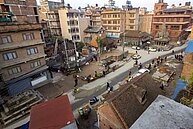
This round tour focuses on the northeastern part of the city of Patan. This quarter is considered to be the earliest settlement of Patan currently inhabited largely by the peasant castes. Starting from Patan Darbar Square, the royal palace of the Malla kings, it takes one through oldest and historically important Heritage Focus Areas such as Cyāsal, Guitaḥ and Nugaḥ. It also includes four traditional Buddhist moansteries, several resthouses (phalcās) and other monuments.
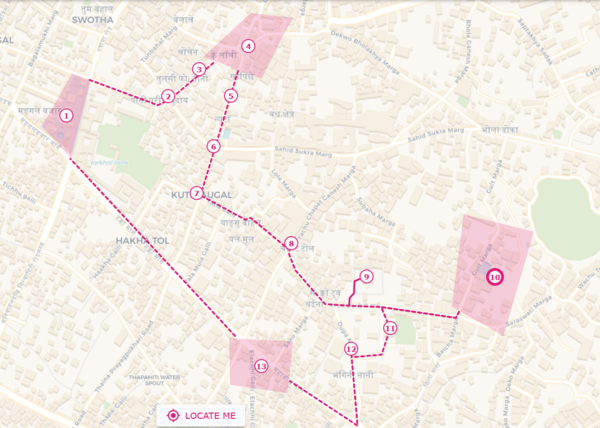
Stations of the Walk
1 - Heritage Focus Area - Patan Durbar Square
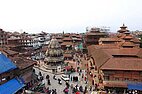
Patan Darbar Square is the heart of the old town of Lalitpur and one of three royal squares in the Kathmandu Valley, all of which are declared UNESCO World Heritage Sites. One of its attractions is the ancient Royal Palace where the Malla Kings of Lalitpur resided. NHDP has documented many previously undocumented monuments located at this Square. The Darbar Square consists of major monuments such as the Krṣṇa Temple (LAL1341), Bhīmasena Temple (LAL1380), Viśvanātha Temple, Viśveśvara Temples, Cāranārāyaṇa Temple, Taleju and beautiful courtyards such as Keśavanārāyaṇa Coka, Mūla Coka and Sundarī Coka.
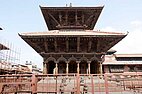
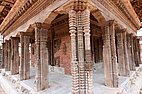
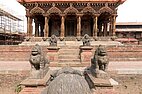
2 - Jora Gaṇeśa Mandira (1682 CE) || जोर गणेश मन्दिर
Walking east from the Patan Durbar Square, one finds this three-storied pagoda temple in the locality of Walakhu. It uniquely enshrines double images of the deity Gaṇeśa besides each other, hence it has the name Jora Gaṅeśa (“A pair of Gaṇeśas”). The temple was built in 1682 and managed by the Jośī families of nearby Bakhuṃ Bāhāḥ Jośī Nani localities.
3 - Bhindyaḥlāchi Phalcā (ca. 1880 CE) || भिन्द्यःलाछि फल्चा
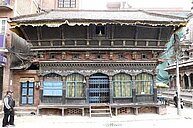
To the north of Jora Gaṇeśa Temple, between Cyāsal and Balkhu, one finds this roadside resthouse. This three-bay structure was rebuilt after it was badly damaged in the earthquake of 2015. It was originally built in the early 19th century by a local family of Avāles.
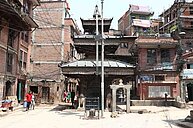
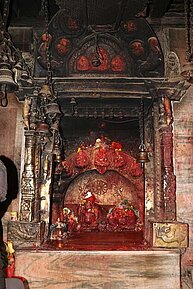
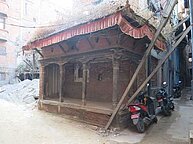
4 - Heritage Focus Area - Cyasal || (च्यासल्)
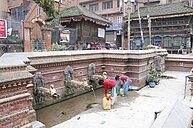
Cyāsal is one of the key monument heritage areas in Patan. Consisting of at least twenty monuments and other votive objects, it is a remarkable habitat of both Newar urban cultural heritage and modern development. The are is home to several ancient artifacts. The Gajalakṣmī image at the Cyāsal Hiti water spout is believed to belong to the 1st century. The locality has got several Licchavi period stone inscriptions. Also, one of the four Cila͂caityas (a unique arrangement of five caityas, the central caitya being surrounded by other four in cardinal directions) in Patan also lies here. Legend has it that it was built or commissioned by the Magadhan King Aśoka. The shadow play believed to have been exhibited since the late 17th century in the Bhailaḥ (Avaḥ Guṭhī) Capāḥ during the festival of Indrajātrā is the cultural specialty of this area. The social life of the residents and bonding among multiple generations is something to be observed here.
5 - Khapiṁchẽ Phalcā (1840 CE) || खपिंछेँ फल्चा
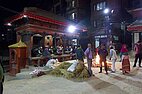
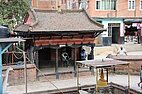
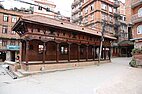
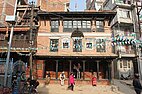
Khapĩche is the locality south of the Cyāsal area. Here one finds in the roadside the resthouse Khapĩchẽ Phalcā. Originally constructed in 1840 CE, it has two floors and five-bayed facade. A small terracotta pinnacle flanked by a pair of small lions can be seen on its roof.
6 - Neuta Phalcā || नेउत फल्चा
On the path further south lies another rest house known as Neuta Phalcā. Lying at Neuta locality, this three-bayed monument was built before 19th-century by the Jośīs of Bakhũ Bāhāḥ locality. It was originally built as a single-storied structure, and reconstructed as a two-storied one after it collapsed in the great earthquake of 1934. It was rebuilt again in 2006.
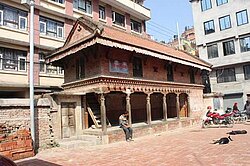
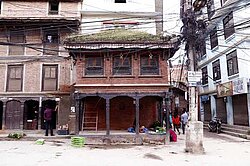
7 - Kutisaugaḥ Phalcā || कुतिसौगः फल्चाा
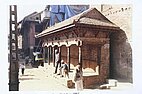
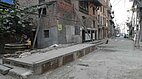
Further south on the western bank of the road that leads to the Saugaḥ crossroads, one finds the five-bayed and single-storied rest house Kutisaugaḥ Phalcā. It was completely destroyed in the earthquake of 2015, and has recently been rebuilt.
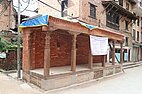
8 - Cvaḥpvaḥ Gaṇeśa Mandira (built before 1744 CE) || च्व:प्व: गणेश मन्दिर
A walk from Kutisaugaḥ locality towards east through the small alley leads one to the temple of Cvaḥpvaḥ Gaṇeśa. This three-storied temple was built around the beginning of the 18th-century. The sanctum enshrines a two-armed Gaṇeśa statue. Locals believe that by worshipping at this temple one finds his lost objects.
9 - Su Bāhāḥ (1142 CE) || सु बाहा:
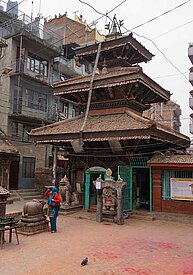
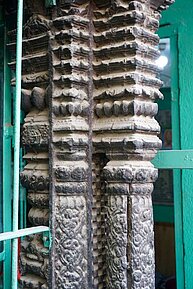
The Buddhist monastery of Su Bāhāḥ, also known as Jayamanohara Mahāvihāra, was established by King Indradeva (r. 1126-1136). Chronicles record that some residents of Viśālanagara, a historical city at the northern side of the Kathmandu Valley, migrated to this place when the city was destroyed in a fire. The main three-storey sanctum building has a central door that is clad in brass sheets and flanked by stone lions. The earliest historical document that refers to this monastery is an inscription dated NS 262 (CE 1142), in which the complex is referred to as Sālako Vihāra.
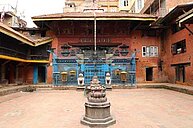
10 - Heritage Focus Area - Guita (गुइत):
Lying at the edge of the Patan, the locality of Guitaḥ is probably the most ancient settlement in the city. The area consists of numerous monuments and votive objects, among which are the three Buddhist monastic compounds, namely Tadhã Bahī, Cīdhã Bahī and Mū Guitaḥ Bahī. Of these Tadhã Bahī dates back to the 6th-century. During the Licchavi period, the settlement of Guitaḥ was known as Gullataṅga-grāma.
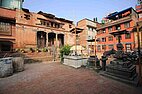
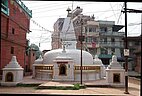

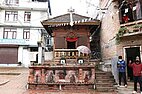

11 - Bhinchẽ Bāhāḥ (ca. 1430 CE) || भिन्छेँ बाहा:
To the immediate south-west of the Guitaḥ Area lies the Buddhist monastery of Bhinchẽ Bāhāḥ. It is one of the most active Buddhist monasteries of Patan, and it is inhabited by a large community of Vajrācārya priests. Epigraphic evidence prove that this monastery existed in the 12th-century. The main shrine is a three-tier building enshrining a metal image of Akṣobhya Buddha. A unique feature of this building is its four corner stone pillars on the exterior masonry wall. The southern wall contains images of Vasundharā, Nāmasaṅgīti and Mahākāla. An image of Hanumān is displayed on the northern wall. This place is famously known for artisans skilled in stone sculptures and religious objects.
12 - Dupāḥ Gaṇeśa Mandira || दुपा: गणेश मन्दिर:
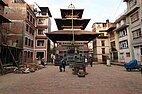
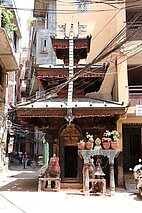
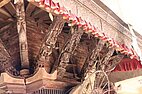
A walk further south-west through the alleyways, one reaches the locality of Dupāḥ consisting of a three-roofed Gaṇeśa Temple, a large community house (capāḥ), and a rest house for musical performances. The Gaṇeśa Temple is a three-tiered temple. The entrance to it is clad in brass and topped with a brass toraṇa. Images of Bhairava, Mātṛkā and Gaṇeśa have been carved into the temple's struts. The temple was reconstructed in 2008.
13 - Heritage Focus Area - Sundhara/Lũhiti/Nugaḥ (सुन्धारा/लुँहिति/नु):
To the west of Dupāḥ is the locality of Sundhārā, also known as Nugaḥ. This ancient city quarter was historically referred to as Nogvala, Nogala, Nugalaka, Nugala and so forth. A Licchavi inscription by Mānadeva from 610 CE (MS 34) mentions this place. Since this locality has a golden spout (Lũ Hiti in Newari), it is popularly referred to as Sundhara. The area consists of monuments such as Bhavānīśaṅkara Mandira, Dathu Bāhāḥ, Tvāya Bāhāḥ, Umāmaheśvara Mandira, Umāmaheśvara Mandira, Ilachen Phalcā, Bhindyaḥ Bāhāḥ, Hyana Bāhāḥ, Llāy Bahī, Nhū Bāhāḥ, Nugaḥ Sataḥ, Lakṣmīnārāyaṇa Sataḥ, Pvāḥsyāḥ Phalcā.


 Datenschutz Impressum