

Kirtipur: a city woven into music
Curated by Pushpa Palanchoke (2022), with support by Bharat Maharjan
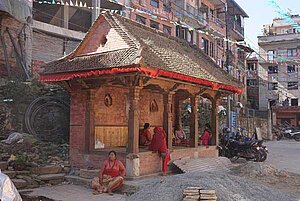
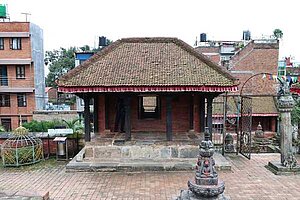
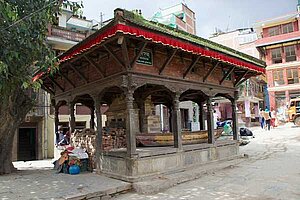
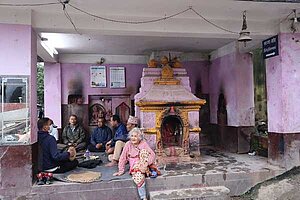
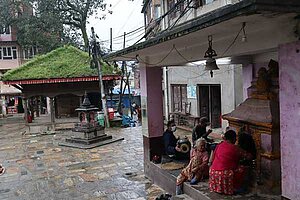
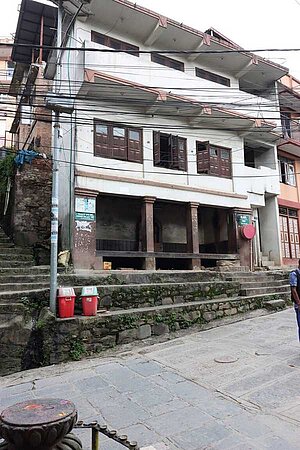
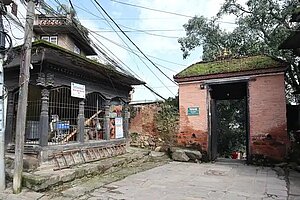
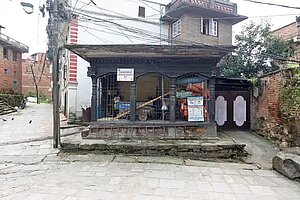
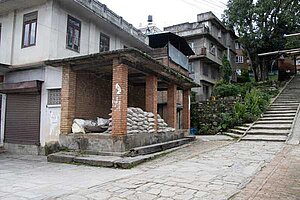
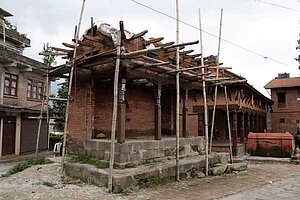
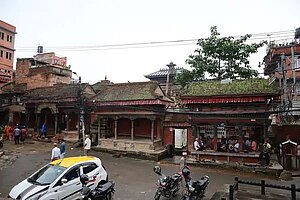
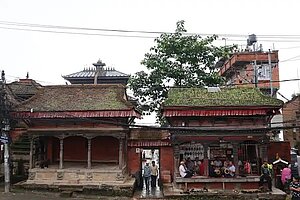
The Newar community of the historic town of Kirtipur celebrates different festivals throughout the year. On particular days, phalcās, one or two storied arcaded rest houses, become a spot to gather for more than just everyday conversations. These gathering places and the activities in and around them are meaningful for musical practices and practitioners. Charged with energy, music performances in phalcās transcend time and space.
This heritage walk will invite you to glimpse into the world of rituals that make these gatherings special. To do so, the walk will provide a specific lens by refering to a special traditional social institution: the music groups (Dāphā Khalaḥs) of Kirtipur. Dāphā is a special music genre common to Newar communities of and around Kathmandu Valley. Dāphā songs are sung from old hand-written text books called saphū. They are composed in a specific rāga (melodic feature, mood) and composed in particular tāla (metric cycle).
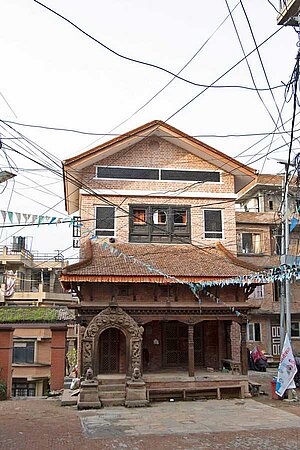
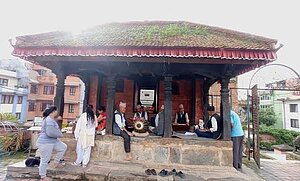
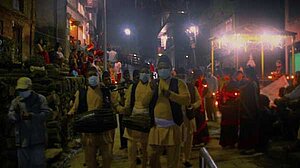
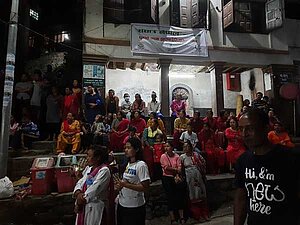
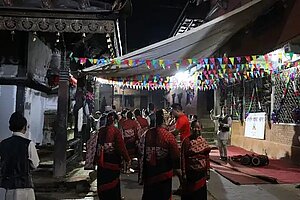
Usually, the music group, Dāphā Khalaḥ, occupy a neighbourhood's phalcā in weekly (sometimes even daily) singing sessions during specific religious months during special hours of the day. Mostly, these sessions take place early in the morning or in the evenings. There are arcaded rest houses (phalcā) that have been built especially for the music performances. With the songs, the group praises the protecting deities and connects the gods to the community and places. Besides paying devotion to the deities through musical performance in the phalcā, a local community also gains religious merit by organizing annual pilgrimages and rituals. These events can be both sacred and secular in nature. Music, masks, dance, procession, traditional costumes and feasts are primary features of these rituals and often engage old and young, women and men.
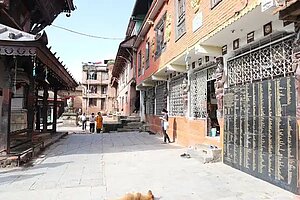
The heritage walk will take you around the historic city of Kirtipur and visit those phalcās relevant for the selected music and festivals of the locality. Although some of the rest houses we visit have been rebuilt recently, often in connection to their demolition during the Gorkha earthquakes of 2015, the music, lyrics and rituals tell a story that underlines the long and dynamic past of the built heritage. The sites speak of the history of Kirtipur, about the city’s transformation, a transformation that has been particularly visible since the 2000s. We have included sound in the walk: As you walk offline or online you can choose to listen to a poem from the 12th century, called Śrita Kamalā, written by Sanskrit Poet Jaydeva. The voice that you will hear one of the first women apprentices of Taḥnani Dāphā Khalaḥ who were initiated into the tradition of Dāphā in 2021. Already this detail shows the dynamics of tangible and intangible heritage: until recently, it was not possible for a woman to envisage and practice apprenticeship and initiation into a music group.
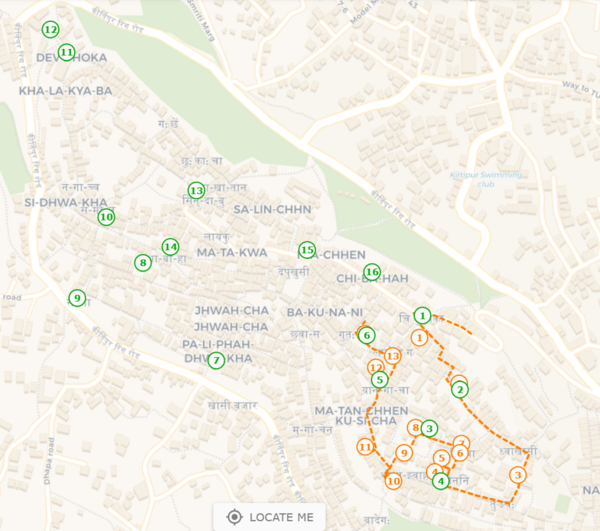
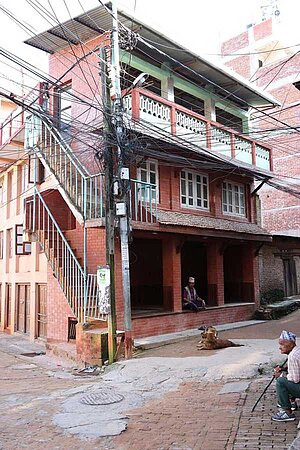
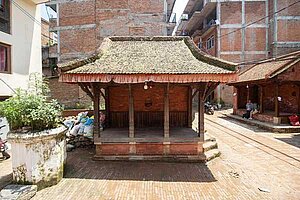
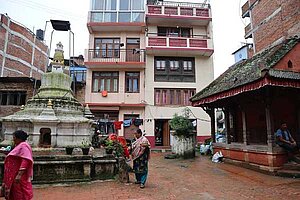
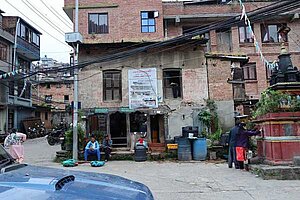
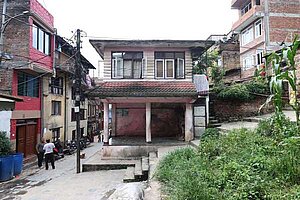
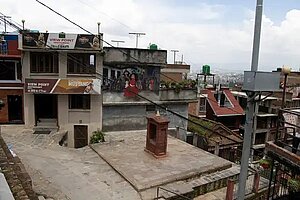
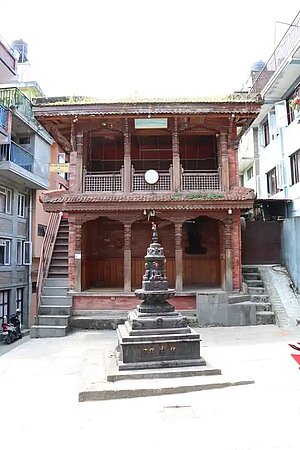
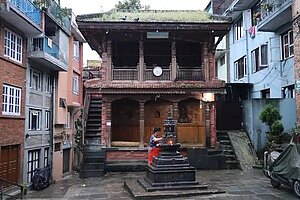
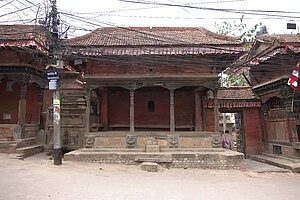
First Walk (green)
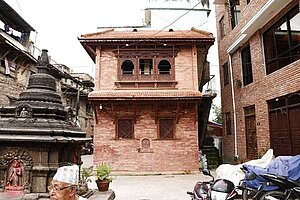
1 - Bringing back ‘lost’ traditions and deities: Cīthū Phalcā || चीथू फल्चा:
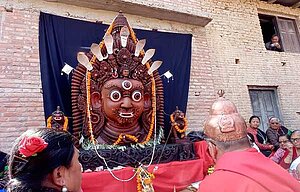
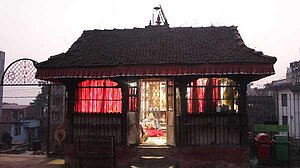
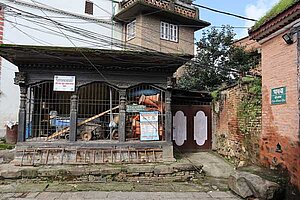
Devotional music is an important ingredient of rituals, for instance, of initiations or inaugurations that are connected to build heritage. One example: On March 1, 2022, two music groups were involved in the installation of a mask of the deity Hāthu Bhairava in a rest house in Kirtipur. Two music groups, the Mānaṃtvāḥ Dāphā Khalaḥ and Taḥnani Dāphā Khalaḥ, offered songs dedicated to Lord Bahirav in front of this newly restored phalcā. Led by the local youth club, the remarkably larger wooden sculpture of protector deity Bhairav that had been carefully crafted in neighboring Bungamati was installed in front of hundreds of participants. With the installation, an annual ritual that had not been celebrated in Kirtipur for decades was reintroduced. From 2022 onwards, on the day of Samaybaji Puhni in the month of September, locally brewed beer (chyang), is offered as sacred substance to devotees from a pipe coming out of the deity’s lips. This act is called hāthu hāykegu, and the particular version of the deity is thus called Hāthu Bhairav. For most of the year, the mask can be seen but is kept behind a carved gate.
2 - Harvest ritual at Taḥnani Phalcā || त:ननि फल्चा ||:
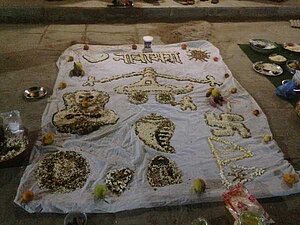
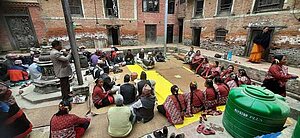
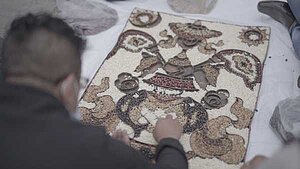
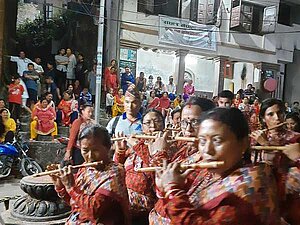
Harvest festivals are central to farming communities in the Kathmandu Valley. In November, precisely on the day of Sakimilā Punhī in the first month of the Newar Calendar, the dāphā khalaḥ of Taḥnani neighbourhood visits the neighbouring town of Bungamati. There, they visit the main deity Buṅgadyaḥ and other deities in the vicinity: the Kārya Vināyaka temple at Bungamati, Rudrāyaṇī Temple at Khokana, and the temples Jala Vināyaka and Ādinātha at Chobhar. Upon their return to Taḥnani, they perform the harvesting festival called halamali pasa teu. While halamali, roasted grains, are often worshipped during the musical dāphā sessions, this special occasion is marked by the fact that the harvesting ritual at the phalcā can only take place after the pilgrimage and the visit of Bāghabhairava temple (KIR0004) in Kirtipur. Here, the musicians pay homage to the Lord of Music, called Nāsaḥ Dyaḥ. When the group finally returns to the neighbourhood of Taḥnani, group members make a spiritual geometric diagram (maṇḍala) made of roasted grains in front of the phalcā, and sing devotional songs. The maṇḍala also underlines friendship within the community. After the session of devotional songs is over, the halamali is distributed among the community members, along with root vegetables like yam. Women play an important role in this, and increasingly more so: the grains and yams are prepared by women. But while previously, participation in music practice was limited to men, women have now started to take up these roles too. In the case of the 2021 pilgrimage, women flute players accompanied the men of Taḥnani Dāphā Khalaḥ.
3 - Neighbourhood rituals at Cilancva Phalcā North || चिलन्च्व फल्चा उत्तर:
A group of female singers of Buddhist hymns, in particular, of Nāmasaṅgīti and tutaḥ, occupy the phalcā to the right of the east entrance of Cilaṅcva Caitya (KIR0001), a monument dating back to 16th century. On special ocassions and in some of the festival months, they are accompanied by other hymn singers and in other phalcās of the neighborhood. The phalcās here are actively included in the conduct of annual rituals in the neighborhood. The Chilancho Bhajan Khalaḥ comes and perform hymns on Phalcā to the left of the entrance gate starting mid-July for a period of four months (caturmāsa). Note that the emphasis here is on bhajan, not on dāphā. Bhajan Khalaḥ and Dāphā Khalaḥ differ from each other in that the bhajan ensemble plays the pascimā drum instead of the khiṃ barrel drum. Unlike the khiṃ drum, pascimā requires different attendance, besides sounding differently. In bhajan khalaḥ performances, additional percussions like triangle and clappers are used - unlike in dāphā Khalaḥs who limit themselves to a pair or two of thick and thin-plated cymbals (tah and baucha). The bhajan Khalaḥ is also accompanied by other instruments, such as the harmonium. The use of the harmonium indicates that bhajan groups historically succeed the tradition of dāphā bhajan.
4 - Mask dance on stage: Tuṃjhvaḥ Gaṇeśa Phalcā (first half of 17th cent. CE) || तुंझ्व: फल्चा २:
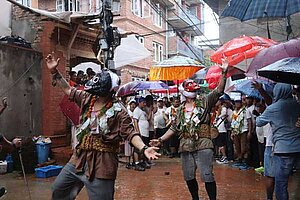
In front of this L- shaped Tuṃjhvaḥ Gaṇeśa Phalcā is a small raised platform, called dabūcā. Literally, this means “stage“, and in many processions, the main performers rest and dance or perform a ritual here. Devotees make offerings to the respective deities who are placed on the dabūcā. A group of processional dancers called Dhẽdhẽpāpā, wearing special masks, stop and perform on the dabūcā on the annual festival of Gāijātrā in August. In this context, dāphā music groups take rounds through the historic city to pay homage to the deceased family members. While the music groups move through the town, members of the Dhẽdhẽpāpā troupe only perform in particular sites to dance, and this Phalcā is one crucial point. The dancers wear four types of masks: a red-coloured mask (Hyāũ khvāḥpāḥ), a mushroom shaped mask (Mkhukaṃ khvāḥpāḥ), a mask in the shape of a fish (Nyā̃tvāḥ khvāḥpāḥ) and a mask divided up by two colours (Bāpāḥ khvāḥpāḥ). They dance along the beats of a percussion band, the dhāḥbājā. The dance is associated with a historic event associated to the attack of Kirtipur by the Gorkhali army in the late 18th century. It is a mockery against a few Kirtipur locals who joined the Gorkhali army and guided the enemy into the otherwise well-protected walled town. Every year a different neighbourhood gets the task of performing this dance. On the same day, the streets of Kirtipur resonate with the sound of other music ensembles.
5 - Praise to Lord Buddha: Mānaṃtvāḥ Phalcā || मानंत्वा: फल्चा:
The dāphā music performing ensembles organize and partake in various ritual events of a Newar town like Kirtipur. The groups of Kirtipur are engaged particularly during four specific religious months of the Newar calendar and do so by sitting in the Phalcās, performing songs of the respective festival, season and for different deities. There is also a difference in that they sometimes sing in the evenings, sometimes in the early morning, during some months they perform daily, on other occasions only on a weekday, such as Saturday. For the tenth Newar month of Guṃlā (around August), the group sits and performs devotional music in the mornings. The month is considered as a season to pay devotion to Buddha, by visiting related shrine or singing praises of Lord Buddha. Praisal hymns of deities like Karuṇāmaya, Śiva, Bhairava, Nāsaḥdyaḥ and the Aṣṭamātrikā (eight mothers) are also sung during the season.
6 - Full moon ritual at Gutpau Cībhāḥ Phalcā || गुत्पौ चीभा: फल्चा:
On the full-moon of the last Newar month of Kaulā in the month of October, the Phalcā in front of the Gutpau Caitya (KIR0021) becomes a platform to celebrate the monument. Members of the community gather from the early morning to clean the caitya and repaint it. On that day, the deity belonging to the caitya is taken outside of the residential house of a guṭhī (ritual association) member for safety reasons. But on that day, it is worshipped openly through various specific rituals. Community members sing hymns in the Phalcā and light oil lamps.
7 - Political ritual of martyrdom: Khāḥsi Phalcā (built in 1682 CE) || खाःसि फल्चा:
This site actually lies outside the historic boundaries of Kirtipur. But it plays an important role for the town, and also for the ritual and musical calendar, albeit predominantly political. The pond (pukhū) is the third of a whole chain of ponds. It used to be a pilgrimage site for Kirtipurians and people would fetch drinking water from its source. It was believed to have healing powers for sick children which is why they were made to walk across the canal in the case of illness. Previously, a canal connected the ponds. Today, a police-station is built right on the canal that has been closed. During the People's Revolution against the then existing panchayat government a multi-party system was demanded. On April 2, 1990, four local activists were shot in front of the khasi pukhu, they were Rājamāna Mālī, Lānabahādura Maharjana, Rājendra Maharjan and Hirākāji Maharjana. Today, Kirtipurians still commemorate the mārtyrs' contribution which is why they organise a procession on the day of their assassination. The procession starts from this very spot. A memorial sculpture of the four martyrs has by now been established on the site. The procession moves through the streets of Kirtipur and returns to the starting point. Modern and traditional educational and social institutions like dāphā Khalaḥs, local guṭhīs, Misā Pucaḥs (women groups), and clubs participate in this event.
8 - Kṛṣṇa rituals at Sāymitvāḥ Bhajana Phalcā || साय्मित्वाः भजन फल्चा:
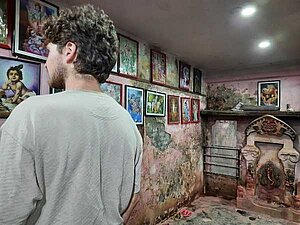
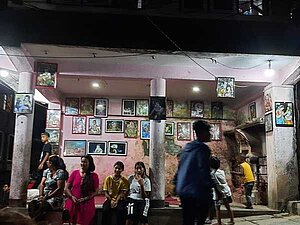
Many music performances that are connected to even smaller heritage sites like rest houses are meaningful because of their connection to the local main deity, for instance, the Sthāna-Gaṇeśa. A Phalcā becomes the exhibition venue for the two days of Guṃlā, Aṣṭamī and Navamī – Kṛṇāṣṭamī– both important festivals in the Hindu calendar (taking place mostly in August). The latter festival day is related to the celebration of Lord Kṛṣṇa birth. While most Hindu communities mark this celebration on aṣṭamī itself, in Kirtipur the Krishna Jātrā, or procession, is brought out on the next day, that is, on Navamī. The mythology associated with Kṛṣṇa narrates that Kṛṣṇa had been taken away from his biological mother as a small child by a wicked maternal uncle who sought to kill every son born to this mother. But Kṛṣṇa survived as a foster son of Yasodā and Nandā. The celebration at Kirtipur seems to be associated more with this very survival of Krishna. While in the morning a Sāḥgāḥ Dāphā Khalaḥ gathers to sing praise of Kṛṣṇa, in the evening of Guṃlā Aṣṭamī, images of Kṛṣṇa are hung inside the Phalcā and remain there until the next day.
9 - Sāḥgaḥ Mandaḥ Phalcā (built in 1750 CE) || सा:ग: मन्द: फल्चा:
This rare construction of a Mandaḥ Phalcā stands on 16 pillars and is located at the Sāḥgaḥ Ṭola, Kirtipur. Another rarity is the emplacement of a jaḥdhu (watertank) in its centre.
10 - Connecting to the sacred: Samala Gaṇeśa Phalcā || समल गणेश फल्चा:
In the holy month of Yaṃlā, the 11th month in the Newar calendar (often in September), Kirtipurians perform Yaṃlāsī Vanegu on every Saturday. The processional ritual features different music groups from neighbourhoods of Kirtipur, at smaller and larger shrines, while playing music. This way, the city is interwoven with the music ensembles and the different neighborhoods. The groups follow a specific route that circumambulates the town in a clockwise direction. Each group waits for a music group from other neighbourhoods to reach their doorsteps before joining the growing procession group en route to the main shrine, the pith of the protecting deity Indrāyaṇī goddess. By the time groups reach Samala Gaṇeśa Phalcā, most of the neighbourhoods have their music bands meet each other and follow one other in the rally.
11 - Indrāyaṇī Procession: opposite to ward office in Indrayani Pith: Dyaḥdhvākhā Phalcā || द्यःध्वाखा फल्चा:
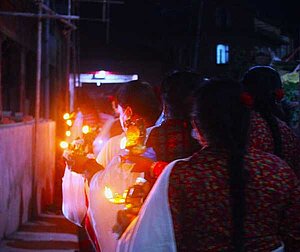
Music, place and lights are closely tied to Newar heritage. This becomes obvious in the context of lighting lamps in front of the central Dyaḥdhvākhā (KIR0040) where the sacred site (pīṭha) of the goddess Indrāyaṇī is. In the 2nd Newar month (thiṃlā), Kirtipur witnesses a series of processions (yātrās) that start their journey only after lighting lamps at the mentioned gate. All those processions end with Indrāyaṇī Jātrā at the Indrāyaṇī Pīṭha (KIR0007). Again, the rest houses are key to the performances, in this case, the Phalcās at the pīṭha. Two nights before the main Jātrā takes place, a ritual is performed in which an all-men group carries the idol of the goddess Indrāyaṇī from her shelter at the Bāgha Bhairava Temple (KIR0004) to the Indrāyaṇī Pīṭha. It is believed that the ritual is meant to be performed secretly, and upon reaching the pīṭha, the statue remains in the custody of the group that brought her over until sunrise. In that very night, the group burns a large tree trunk and sleeps in the arcaded rest houses (the act is called goṃsĩmĩ cyākegu). Each year, a different group from the historic city gets the chance to perform this particular role. On the next day, some guṭhī members embellish the chariot, while others light oil lamps in one of the Phalcās next to the entrance to Indrāyaṇī Pīṭha (KIR0007).
12 - Singing and feasting for Indrayani: Phalcās at Indrāyaṇī shrine. Pīgaṃ Phalcā 3 || पीगं फल्चा ३:
On the day of Gaṭasṭhāpanā related to the Indrāyaṇī procession, the Phalcās at Indrāyaṇī Pīṭha are occupied by different dāphā Khalaḥs from across the town who sing praises of the deity. Once the singing has been completed, the music group, accompanied by neighbourhood members, proceeds to celebrate a special feast (pāru bhvay).
13 - Feasting for good spirits: Kvāḥcva Khyālidyaḥ Phalcā || क्वाःच्व ख्यालिद्यः
In front of the Umāmaheśvara Temple (KIR0006) stands a statue of deities Lakṣmī and Nārāyaṇa in a small site. They are referred to as Khyalidyaḥ, the Lord(s) of Romance. The aim had been to install the sculpture with the help of the Khyalidyaḥ Samrakṣaṇa Guṭhī in this 16-pillered Phalcā, or maṇḍapa. On the day of Samaybaji Puhnī in the Newa month of Yaṃlā, the guṭhī engages in reviving the tradition of distibuting ritual food (Samaybaji). For the ritual feast, each household from the neighbourhood is meant to offer different dishes, which are then put on display in a form of a mandala. At the end of the ritual, the dishes are mixed and distributed among the visiting devotees. There's a saying among local residents that one’s love is fulfilled in prayers to the deity, and fear is reduced. The Phalcā is believed to symbolise this sentiment.
14 - Women’s presence at Thāṃbāhāḥ Bhajana Phalcā || थांबाहा: भजन फल्चा:
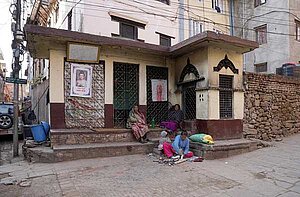
The Thāṃbāhāḥ Dāphā Khalaḥ have a very distinct feature: unlike most Dāphā Khalaḥs who are designated to one single Phalcā for their routine month long singing sessions, this Khalaḥ has two different Phalcās to sing at. And both Phalcās have very particular features. One is a rare L-shaped Phalcā in Kirtipur’s Durbar Square area, the other is two-storied and stands in a courtyard of Thāṃbāhāḥ. During the fourth month of the Newar calendar, Pohelā, the Dāphā Khalaḥ starts singing the Dāphā Bhajan on Pohelā Puhnī, on the full-moon of January and continues for a month. They use the L-shaped Phalcā in the Lāyakū Durbar Area for morning Dāphā singing. While community men gathering and singing at these Phalcās is a common sight, it is very rare to find a female figure sitting and singing along the all-men group. During daytime and in the evening hours, women use the Phalcās' space both for vending pāna (juicy spices to chew on) aimed at domestic tourists that flock to this area that is crowded with restaurants. The women also occupy the space for chores like grinding grains. The dāphā singing sessions, however, have never had any women musician members. Though it is the women population itself who serve as devotees to deities installed within the Phalcās' premises, they were barred from musical activities so far. But this is changing. After a 22-year gap, the Thāṃbāhāḥ Dāphā Khalaḥ has now, in 2022, announced a new apprenticeship program. The masters informed that the targeted group for this apprenticeship are bhau-misā, the daughter-in-laws of the community.
15 - Phalcās Bāgha Bhairava Temple: Ārīthāy Phalcā || आरीथाय् फल्चा:
1) Phalcās outside the gate: Many annual rituals in Kirtipur underline that agriculture is key to the communities. The Phalcās on and around the premise of Bāgha Bhairava Temple (KIR0004) are usually always occupied by local residents. On auspicious days, they are particularly crowded with spectators and devotees. On the day of Gathāṃmugaḥ Caḥhre, in the month of July, people gather to watch the spectacle of burning Ghaṇṭākarṇa, that is, the representation of a large ghost figure (made of rice straw), and the representation of germs, diseases and lethargy. With the end of the plantation season, after a thorough cleaning, each household is ritually cleansed with the smoke of burnt rice straw (chvāli). After this day, the Dāphā Khalaḥs which remain inactive for the whole rainy season prepare themselves for upcoming musical months. On the third day of this ritual, which is also the beginning of the ritual month of Guṃlā, the Gũdey Dāphā Khalaḥ begins the month-long morning Dāphā singing sessions at their designated Phalcā (KIR4021). 2) Phalcā infront the Nāsaḥdyāḥ Shrine inside the premise: Nāsaḥdyaḥ Capāḥ (KIR4026). This Phalcā is designated to a hymn group and welcomes the devotees visiting the shrine to sit and perform worship songs everyday. Right in front of it is a shrine of Nāsaḥdyāḥ, the lord of music and dance. The space between the Phalcā and the shrine is used by different music bands who come to make ritual offerings to the Nāsaḥdyāḥ on different occasions- from beginning or closing of any musical apprenticeship to the marking of special processions. One such event takes place when Taḥnani Dāphā Khalaḥ's troupe of masked-dancers of Devī Pyākhaṃ sings and dances in the space between the shrine and the Phalcā. On Kaulā thva Daśamī, in the month of September, Taḥnani Dāphā Khalaḥ's troupe of musicians and dancers perform a dāphā song called 'Nāsaḥ Gvārā' in praise of the Lord of music. The dancers wear masks of the protector deities Indrāyaṇī, Bhairava and Bramhāyaṇī. After their performance in front of the shrine, the members of the music ensemble move towards their own neighbourhood, Taḥnani. They end the procession after having walked through the historical part of the town.
16 - Connecting cities: Ichẽ Cibhāḥ Phalcā (1698 CE) || इछेँ चिभा: फल्चा:
Kirtipur and Patan have a history of a well-oiled relationship. For the Buṅgadyaḥ Jātrā of Patan, when the high chariot is drawn from Lagankhel to Jawalakhel, the people from Kirtipur lead the chariot pulling. They still do so. This feature, and Kirtipur’s participation in rituals outside of the town, is also celebrated and praised by many who cannot accompany the processions and stay back in Kirtipur. The Dāphā Khalaḥs at Kirtipur make music offering during that time, and when there were not that many buildings back in time, one could watch the procession from special locations in Kirtipur as it moves towards Patan. While urban transformation has proceeded in such a way that the procession is not visible any more, the Dāphā Khalaḥs still accompany the procession from afar by offering devotional singing. On the day of Bhoṭo Jātrā, in Patan, the Guṃdey/ Ichẽ Dāphā Khalaḥ who do not travel to Patan, plays music in front of the small caitya on the squared yard in praise of Karuṇāmaya.
Second Walk (orange)

1. Cīthū Bahī || चीथू बही
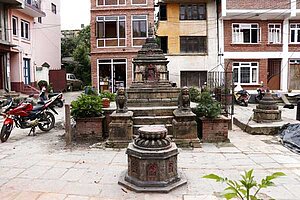
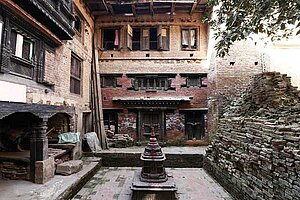
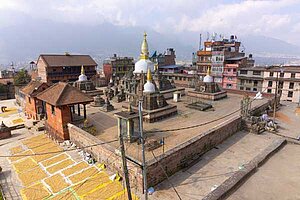
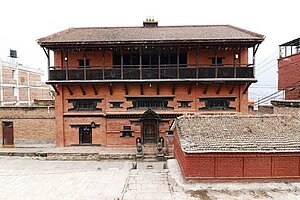
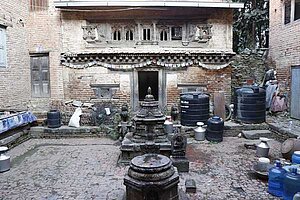
This monastic building is part of one of the largest Buddhist neighborhoods in Kirtipur. The place is also known under its Sanskrit name, Padmakīrtigīri Mahāvihāra. Though there are no records of the initial construction, an inscription from 1659 CE (NS 779) refers to Cīthū Bahī as a monastery (Kittipura, corr. Kīrtipura Vihāra and Kīrtipuri Vihāla). At that time, it was particularly housing the sacrificial fire (agniśālā). Land endowed to Cīṭhū Bahī was appropriated by the government in 1956 CE to establish the Tribhuvan University. In 2014, members of the Kirtipur Śākya community joined to rebuild the shrine (dyaḥchẽ) building. A new statue of Maitriya has been replaced in the sanctum.
2. Taḥnani Caitya || त:ननि चैत्य
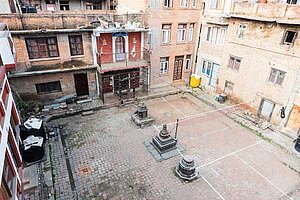
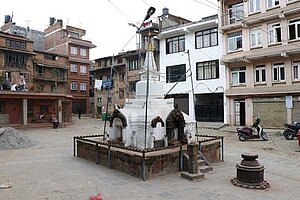
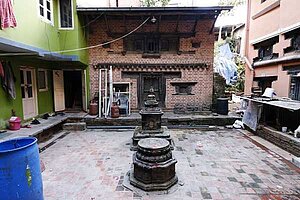
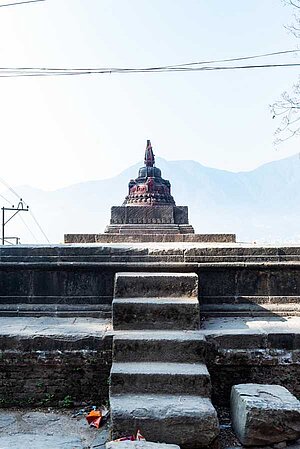
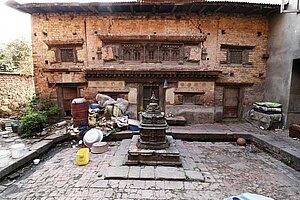
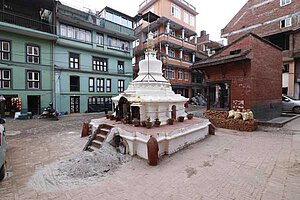
Taḥnani Caitya stands at the centre of a large residential courtyard called Taḥnani, north of the Cilancva Caitya premises (KIR0001). The Caitya’s plinth has six inscriptions, the oldest dating back to 1665 CE (NS 785). An inscription that is not at the place any more, dated back to 1630 CE (NS 750) records the donation of a golden parasol, as well as the renovation of the Caitya, and the addition of niches (gavākṣa) for the statues of the Dhyānī Buddhas. Tahnani courtyard is home to a very active musical practice of devotional music (dapha khalaḥ) across the site and sometimes the whole historic city (see the heritage walk by Pushpa Palanchoke).
3. Mātakhyaḥ Śikharakūṭa Caitya || मातख्य: शिखरकूट चैत्य
This Caitya is situated at the rectangular courtyard of the Mātakhyaḥ ṭola, close to the eastern border of Kirtipur. The shrine houses four Lokeśvara, one on each side of its main body: Maitreya (east), Vajrapāṇi (south), Padmapāṇi (west) and Mañjuśrī (north). The Caitya is also worshipped during the annual procession of the Buddhist monuments in Kirtipur in memory of those who died within that year. In the night of Gunpunhī and the following morning, family members of the deceased walk the city, accompanying a priest.
4. Kvay Bāhāḥ (1701 CE) || क्वय् बाहा:
Constructed in 1701 CE (NS 821), Kvay Bāhāḥ is another monastic branch of Cilancva Bāhāḥ (KIR0002). On the tenth day of the Dashain festival in autumn, a tantric ritual is performed inside the monastery’s prayer room (āgaṃ) where the secret deity is housed. Following this ritual, upon exiting the deity’s house (dyaḥchẽ) and still on the premises of the monastery, some ritual performers sacrifice an orange color pumpkin with a sword (khaḍga). This ritual, usually conducted only in the abodes (pīṭha) of the Goddesses, is quite unique.
5. Cvay Bāhāḥ (probably built in 1642 CE) || च्वय् बाहा:
Cvay Bāhāḥ (Harṣakīrti Mahāvihāra) is one of the monastic branches of the Cilancva Bāhāḥ (KIR0002). The oldest inscription installed here dates from 1642 CE (NS 762) and mentions that a person called Hākuju installed a Śākyamuni Buddha statue as well as a caitya. In the course of time, following the completion of the monastery, the statue was consecrated as the Bāhāḥ’s principle deity. The statue was replaced later by the present-day Akṣobhya statue.
6. Buddha Mandira (1649 CE) || बुद्ध मन्दिर
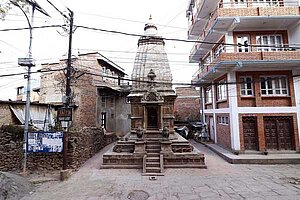
Buddha Mandir, built in 1649 CE, is a rare example of a śikhara-styled Buddhist stone temple in Kirtipur, in the memory of the donor’s parents. When the initial construction of this temple was completed, the pinnacle (gajū) was mounted on top of the temple’s roof and a statue of Śākyamuni was installed in its sanctum. This was followed by a fire sacrifice.
7. Lokeśvara Mandira (1684 CE) || लोकेश्वर मन्दिर
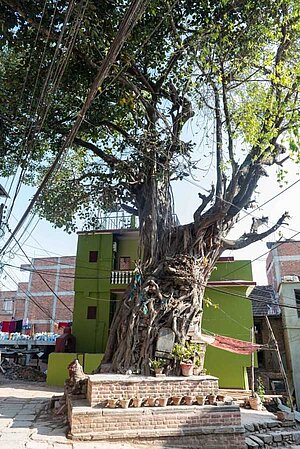
This Lokeśvara temple was built in 1684 CE (NS 804). It is another rare Śikhara-styled Buddhist temples in the Kathmandu Valley. What makes it additionally interesting is its symbiosis with a Bodhi tree. This has not kept people from worshipping the temple.
8. Cilancva Caitya (1515 CE) || चिलन्च्व चैत्य
Cilancva Caitya is situated at the highest point in the eastern part of Kirtipur and is believed to be constructed by the Maurya Emperor Aśoka. The Caitya is the oldest and largest of its kind in Kirtipur. An inscription recording the initial construction of this monument in 1515 CE (635 NS) is attached to the Caitya’s plinth. It also describes different stages of the construction process and praises. Jagatapāla, a representative of the local political elite (Mahāpātra) from Patan, commissioned this Caitya.
9. Cilancva Bāhāḥ (ca. 1515 CE) || चिलन्च्व बाह:
This monastery was constructed in 1515 CE and is listed as one of the larger Buddhist monasteries, or Mahāvihāras, Kingdom of Patan. It is run by a spiritual brotherhood (saṅgha) consisting of members from the Śākya and Vajrācārya clans. Each Vajrācārya member is responsible for carrying out the daily worship for two weeks throughout the year. The ritual worship is followed by devotional music called gambāḥsĩ, which is a unique feature of monasteries in the valley.
10. Majāḥdegaḥ || मजा:देग:
This Caitya stands on a steep slope to the south of the Cilancva Bāhāḥ (KIR0001). It is built on top of a four-layered stone plinth. Compared to other caityas in Kirtipur, the plinths of the Majāḥdegaḥ are larger in size. There is no evidence to date the initial construction of this monument. However, the motifs that are carved on this Caitya suggest that it was possibly built between the seventeenth and eighteenth century.
11. Kusi Bāhāḥ (ca. 17th-18th Cen.) || कुसि बाहा:
Kusi Bāhāḥ is also part of the network of monasteries related to Cilancva Bāhāḥ’s. Its date of construction is unknown but the woodcarvings on the deity’s house (dyaḥchẽ) can be dated back to the seventeenth and eighteenth century. A Vajrācārya family resides in front of the monastery and members of the brotherhood (saṅgha) of the Cilancva Bāhāḥ (KIR0002) are responsible for maintaining it and carrying out the rituals.
12. Yākaḥ Bāhāḥ (1647 CE) || याकः बाहाः
This branch of the Cilancva Bāhāḥ (KIR0002), called Yāka Bāhāḥ, was built in 1647 CE. An inscription from 1680 CE (801 NS), installed on themonasterie’s premises, attests that it was built by a Vajrācārya family. It also mentions that King Siddhinarasiṃha Malla was present during the inaugural ceremony, which attests the importance of the building.
13. Lvaṃha Degaḥ (1664 CE) || ल्वहं देग:
The Lvaṃha Degaḥ temple is another rare example of Buddhist Śikhara temple architecture in the Kathmandu Valley. According to an inscription on the middle plinth of the temple, the initial construction was started in 1663 CE (784 NS). Here too, King Śrīnivāsa Malla attended the inauguration and consecration ceremony.
14. Gutpau Caitya || गुत्पाै चैत्य ll
This Caitya holds a statue of an Akṣobhya Buddha inside its front niche. The niche is adorned with a stone toraṇa that holds a statue of the Pañcabuddha (Five Buddhas). The oldest inscription in the Caitya is dated 1709 CE (Ns 829). It records an offering of a small gilt umbrella (chatra), a garland, and a crest-jewel (cūḍāmaṇi) to the Caitya. A religious association (guṭhī) made up of members of the local Jyāpu community is still active here and organises various religious activities on site on the full moon day of Asoja.


 Datenschutz Impressum