

Buṅgadyaḥ Procession in Patan
A heritage walk curated by Christiane Brosius and Monalisa Maharjan (2021)
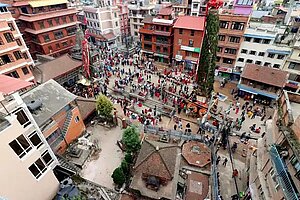
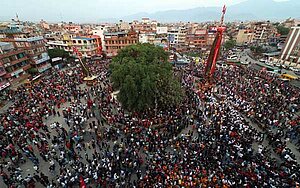
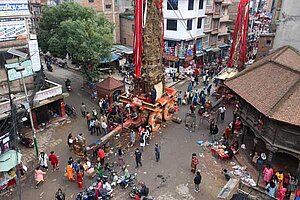
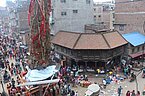
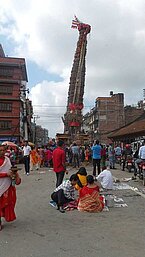
The chariot procession (rathayātrā) of Buṅgadyaḥ is performed to ask for rain and a good harvest. It is associated with fertility and with water and snake deities. It sets out from Pulchok, close to the western Aśoka Stūpa of Patan (LAL0610) where the chariot is built and pulled through the historic city of Patan. The final stop is Jawlakhel, where a small jewelled vest (bhoṭo), believed to have been worn by Buṅgadyaḥ, is displayed. The procession commences on the fourth day of the bright fortnight of Vaiśākha (April-May) and lasts up to several months.
Apart from the annual procession in Patan, the deity is taken on an extended procession every twelve years. The chariot is then built in Buṅgamati (see Heritage Focus Areas) from new materials, except for the gilded parts. It is pulled cross the Nakhu River, through Bhanimandal in the south of Patan, Jhamsikhel, and the historic city of Patan before returning to Buṅgamati.
The procession highlights the involvement of local communities in ritual activities and the responsibilities of guthis established to ensure the correct performence of rituals and to look after the sites where they take place. Sometimes, inscriptions are fixed in the rest houses (phalcā) along the route regulating the provision of food to the deity and to devotees and ritual experts, the lighting of oil lamps, and the distribution of ritual food (samaybaji) including items such as curd, beaten and popped rice or dried beans, and rice beer (thvaṃ). Members of the guthi and individual households deliver ritual offerings when the chariot, accompanied by a smaller chariot of Mīnanātha, stops at specified locations on the route.
The auspicious dates and times of the Buṅgadyaḥ procession are defined by astrologers in the northern Maṇimaṇḍapa (LAL1361) at the Patan Darbar Square. In the last two weeks before the procession starts, around 40-50 members of the Bārāhī caste (carpenters of the Buṅgadyaḥ chariot) get involved in constructing the chariot (ratha) at the Dhaḥmā Phalcā (LAL4306) and other places, especially Taḥ Bāhāḥ.
The procession route includes locations such as Gā Bāhāla, Nugaḥ (Sundhārā), Lagankhel, Thati and Jawlakhel where it ends with the display of the bhoṭo.
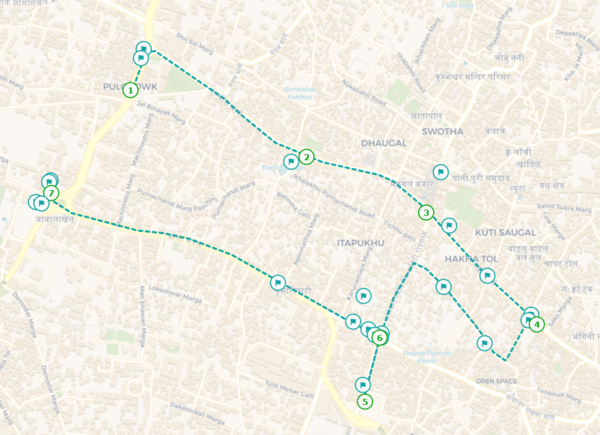
The numbers indicate the procession’s stopping points, while the other icons represent key monuments along the route.
Stations of the Procession
1 - Pulchok
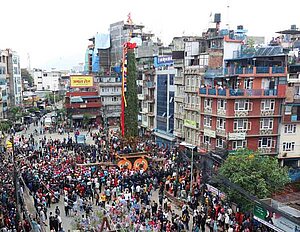
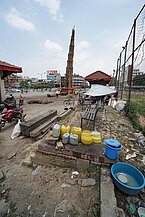
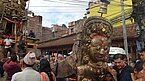
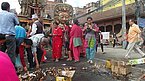
At Pulchok, one of the busiest traffic hubs in Patan, we also find the starting point of the procession, here, the chariot is assembled, the deity ascends the chariot and people start worshipping and pulling it.
2 - Ga Bahal
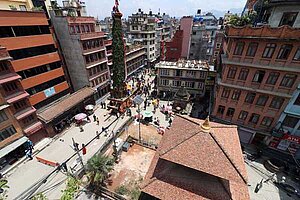
The chariot of Buṅgadyaḥ makes its first stop at Gabahal, a lively square east of Pulchok. It remains there overnight before being pulled onward to its next destination.
3 - Mangal Bazar
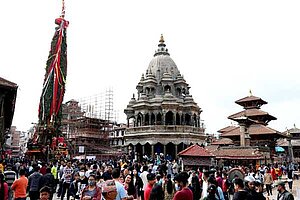
At the crossroads of Mangal Bazar, the chariot makes its second stop. According to legend, this spot was once a river, and the chariot symbolically performs a river crossing here. The tradition of halting the chariot at this site has been revived in recent years.
4 - Nugah (Sundhara)
The third stop, with an overnight stay, is at Nugaḥ (also known as Sundhara), located east of Patan Darbar Square. Here, the chariot is ceremonially turned before continuing its journey southward toward Lagankhel.
5 - Lagankhel
The next stop is Lagankhel, a bustling junction in the southern part of Patan. Here, the chariot circumambulates the shrine of Dolaṃ Māju, the mother of Buṅgadyaḥ. After an overnight stay, it is pulled a short distance north to Thati.
6 - Iti Tol
The fifth stop is at the crossroads of Iti Tol, located a short distance north of Lagankhel. From Lagankhel to this point, the chariot is pulled exclusively by women. It remains here for several weeks until an auspicious date is determined and announced by astrologers at the Manimandapa, situated beside Patan Durbar Square. Thereafter, the chariot proceeds to its final destination, Jawalakhel.
7 - Jawalakhel
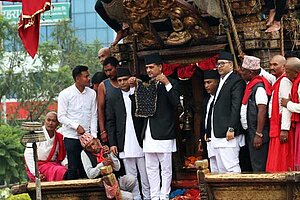
The chariot of Buṅgadyaḥ makes its final stop at the bustling square of Jawalakhel. At the climax of the procession, the sacred bhoṭo (mythical vest) is ceremonially displayed to the public in the presence of the head of state — a role once held by the king. Afterward, the image of the deity is removed from the chariot and carried back to Bungamati on a palanquin. The chariot itself is promptly dismantled, and its reusable parts are stored in various locations, including the Guthi Sansthan office at Ta Bāhāḥ.

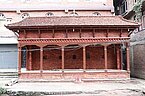

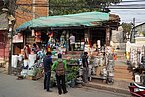
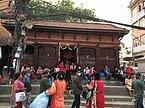
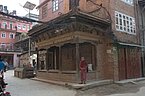

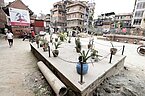
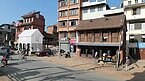
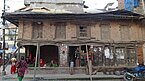
Key Monuments
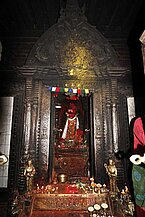
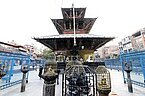
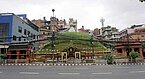
p1. Matsyendranātha Mandira (before 15th century) || मत्स्येन्द्रनाथ मन्दिर
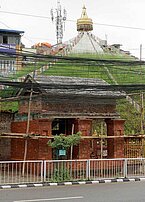
Unless he is taken around in the context of the annual procession, Bungadhyo or Matsyendranātha spends six months in this temple and the rest of the year in his temple in Bungamati (BUN0001). When in Patan, he is kept in the Matsyendranātha temple
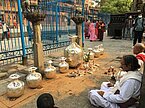
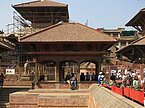
p2. Maṇimaṇḍapa, North (renovated 1701 CE) || मणिमण्डप
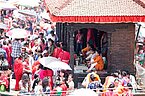
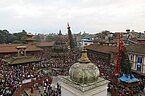
Four astrologers from Patan sit together in the Maṇimaṇdapa to decide upon the auspicious date and time on which the statue of Buṅgadyaḥ or Matsyendranātha should be brought from Buṅgamatī to Patan. The astrologers also determine the date for the bhoṭojātrā and inform the public of this.
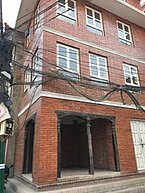
p3. Jāvalākhela Phalcā 4
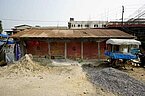
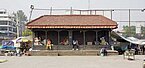
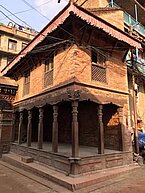
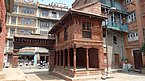
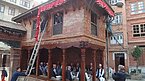
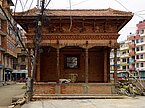
This Phalchā stands in front of the Lalitpur Ward office. It is used to store the painted wheels of the Buṅgadhyaḥ chariot.
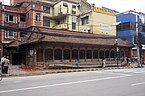
p4. Jāvalākhela Phalcā 3 (ca. 19th cent. CE) || जावलाखेल फल्चा ३
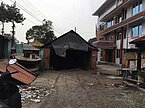
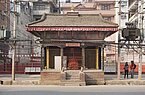
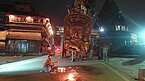
Although the Phalcā is deserted, tantric priests perform rituals in front of it at midnight before the arrival of the Bhoṭo procession.
p5. Jāvalākhela Phalcā 2 (ca. 19th cent. CE) || जावलाखेल फल्चा २ी
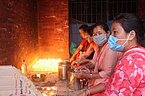
For four days, the chariot remains in front of the restored Phalcā 2, West of Jāvalākhela Phalcā 1, before it is finally dismantled. From the day that the chariot reaches Jawlakhel until the day of Bhoṭoyātrā (i.e., the last day of the months-long procession, when the the jewelled vest of Buṅgadyaḥ, is exhibited), the Matsyendranātha Mṛdaṅga Bhajana Khalaḥ sings devotional songs every morning and evening inside the Phalcā. During the chariot's halt at Jawlakhel, devotees come to the Phalcā to light butter lamps.
p6. Jāvalākhela Phalcā 1 || जावलाखेल फल्चा
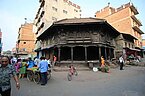
The final destination of the Buṅgadyaḥ chariot is the Jawlakhel quarter where four phalcās became especially important for the rituals. From Jāvalākhela Phalcā 1 located to the south, the Kumārī observes the display of the bhoṭo, the climax of the procession. On other days of the festival, the Phalcha is used by visitors for lighting butter lamps.
p7. Kumārī Pāṭī || कुमारी पाटी
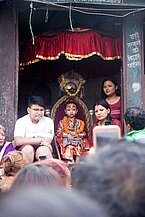
At this place, the Kumārī of Patan observes the procession while seated on her throne, which is why the Phalcā is called Kumāri Pāṭī. Today, the entire neighborhood is named after this event.
p8. Bhajana Phalcā (c. 1800s CE) || भजन फल्चा
This restorated Phalcā, as mentioned in an inscription attched to the wall, is used for the performance of devotional chantings since at least 1823 CE. It is further recorded in the inscription that devotees should light butter lamps and distribute samaybaji during the chariot procession and Indrajātrā and should organise feasts for the guthi members.
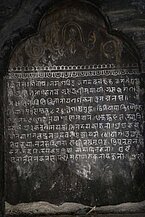
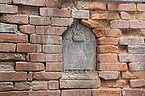
p9. A stone slab inscription at the Dabū Phalcā at Thati in Lalitpur re the construction of the phalcā by Narahari Bhāro and his wife Vasumuni (NS 824)
This inscription, dated 1704 CE (NS 824), records the construction of at Dabū Phalcā (LAL4109) and a dabū (elevated platform) by Narahari Bhāro and his wife Vasumuni, residents of the Dhaugāḥ Bahī area. The text of the inscription begins with the adoration to Lord Śiva while the subsequent verses are dedicated to Sūrya, but the phalcā and dabū are dedicated to Karuṇāmaya, another name of Buṅgadyaḥ, who in the inscription is also revered as Viriñcinārāyaṇa. A senior citizen of the Khaḍgī caste from Thati recalls her grandfather sharing his memories of the Sikālī dance of Khokanā being performed at the dabū next to the phalcā (see LAL4109).
p10. Laganakhela Phalcā || लगनखेल फल्चा
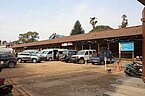
The five-bayed Laganakhela Phalcā is managed by a local committee, the Laganakhela Bhajana Maṇḍala, and rented out to four shops. The Kumārī from Patan visits Laganakhela Phalcā three times a year for religious events: at the time of the Buṅgadyaḥ's annual bathing, which takes place on the first day of the dark half of the month of Vaiśākha, when Buṅgadyaḥ's chariot arrives at Lagankhel, and on the day when the chariot is pulled around the mãsima (the tree located at the centre of Lagankhel). At these occasions, the Kumārī sits on a small throne in the central bay of the Phalcā to observe the activities and receives devotees.
p11. Thati Buṅgadyaḥ Sataḥ || थति बुङ्गद्यः सतः
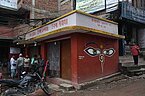
Thati Buṅgadyaḥ Sataḥ is located at the north-eastern corner of the crossroad of Thati Ṭola and it is one of the stops on the annual procession of the Buṅgadyaḥ chariot, despite the fact it has been completely reconstructed and is now rented as a shop. Custom dictates that the chariot of Buṅgadyaḥ must stay at the crossroads for a period of time during the annual festival of the deity. Pānejus reside inside the Sataḥ during the festival and perform tantric rituals there. After its renovation in 2008, the Sataḥ (which belongs to the “32 Pāneju Saṃgha”) was leased out to a person from a Vaidya caste under a contract of twenty years. According to the members of the Saṃgha (spiritual committee), the lease-holder has agreed to keep the sleeping room and kitchen vacant for the whole year that the Pānejus need to organise their tantric rituals and feasts.
p12. Thati Phalcā || थति फल्चा
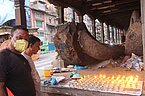
Thati Phalcā managed by a Śākya Guthi was reconstructed in 1980 CE using modern reinforced cement concrete. These days it is used as a shop. Two images of Tārā and one of Padmapāṇi Lokeśvara are attached to the inner wall of the building. During the Buṅgadyaḥ procession, the chariot rests in front of the Phalcā for a few days. From there, it is taken to Jawlakhel when the astrologer agrees upon the right moment for the continuation of the procession. While waiting, devotees light 108 butter lamps inside the Phalcā after the shopkeeper has emptied the building.
p13. Thati Sataḥ (c 1831 CE) || थति सतः
Thati Buṅgadyaḥ Sataḥ is located at the north-eastern corner of the crossroad of Thati Ṭola. The Pānejus (priests of Buṅgadyaḥ) reside inside the Sataḥ during the festival and perform tantric rituals. After its renovation in 2008, the Sataḥ (which belongs to the “32 Pāneju Saṃgha”) was leased out to a person from the Vaidya caste under a contract of twenty years.
p14. Lũchẽ Nani Phalcā (1668 CE) || लुँछेँ ननि फल्चा
Located between Oku Bāhāḥ and Taṅgaḥ, this Phalcā is used by the Matsyendranātha Mṛdaṅga Bhajana Khalaḥ (a group singing devotional songs ‘bhajana’) for its crucial role in accompanying the Buṅgadyaḥ procession. Every morning the group sings here and at Taḥ Bahāḥ (LAL0060) bhajanas.
p15. Thapāḥ Phalcā (ca. 19th cent. CE) || थपाः फल्चा
Thapāḥ Phalcā is located at the crossroads leading from Thapāḥhiṭī to Jyāthā. The structure has a caitya-shaped pinnacle, which is a rare addition to a phalcā. In 2003, the Phalcā was jointly renovated by the municipality and a donor from the Avāle (Kumāle) community. The Thapāḥ Kumāḥ Guthi used to display a Bhairava mask here twice a year: once on the day when the chariot of Buṅgadyaḥ is pulled away from Sunadhārā and once on the day of the Indrajātrā festival. The tradition came to an end in the 2010s. The mask is now kept inside the house of a member of the Avāle community.
p16. Nugaḥ Phalcā 3 || नुगः फल्चा ३
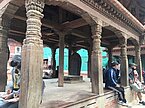
This is a rare type of mandaḥ phalcā that used to stand free and have 16 columns. Before it was closed off by lattice work, devotees would come to the Phalcā to light 108 butter lamps when the chariot reached the junction at Sundhārā and stayed over night.
p17. Pvāḥsyāḥ Phalcā || प्वाःस्याः फल्चााा
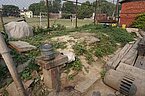
This Phalcā was dismantled in 1979 CE (VS 2036) and turned into an elevated open space. The remnants of the site are important as the chariot of Buṅgadyaḥ stops here. The elevated platform is used to view the procession and light butter lamps.
p18. Jośī Sataḥ at Saugaḥ (1842 CE) || सौगः सतः
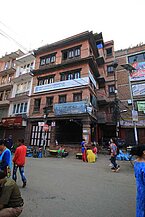
This arcaded resthouse was demolished in June 2019. It was once a two-storey sataḥ, owned by a Jośī guṭhī. This structure has now been replaced by a four-storey concrete building, and has been converted into a commercial, privatized space.
When it was still intact, the Pānejus used the upper storey of this Sataḥ to spend the night there when the chariot of Buṅgadhyaḥ stopped at Nugaḥ. This custom lasted only a few years in the 1980s CE - afterwards, the Pānejus relocated to a place at Nugaḥ Ṭola.
p19. Kota Pāṭī (c. 1700 CE) || कोत पाटी
Since this is one of the overnight haults for the chariot, for several nights, this space just next to Patan Darbar Square was for a long time used by worshippers to view the procession and light butter lamps. Today, it has been converted into a parking space, the arcaded rest house itself is now made up of shops.
p20. Puncali Phalcā (before 1819 CE) || पुन्चलि फल्चा
Puncali Phalcā is located at Gāḥbāhāḥ and faces one of the places where the chariot stops. It is one of four phalcās situated around the Puncali pond. The date of the initial construction of the Phalcā is unclear, however an inscription at the Phalcā from 1819 CE (NS 939) records that Thākusiṅ and Toyuṣvā Thakunī, a couple from the nearby Valā Ṭola, funded its restoration. The inscription further mentions that some plots of land were endowed to the guthī of the Phalcā to organise its annual worship (varṣavardhanapūjā). It was restored again after 1946 CE (VS 2003), probably because it had been damaged during the 1934 earthquake. In 2019 CE, after the 2015 earthquakes, the Phalcā was rebuilt with funds from the Lalitpur Municipality. An inscription from 1819 CE orders the guthi members to light three oil lamps on the day when the Buṅgadyaḥ chariot halts here.
p21. Nāmasaṅgīti Phalcā (constructed before 1968 CE) || नामसङ्गीति फल्चा
This Phalcā is used to light butter lamps during the chariot procession. This ritual takes place in the newly restored Phalchā.
22. Dhaḥmā Phalcā || धःमा फल्चा
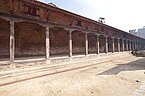
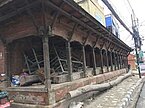
The shafts (dhaḥmā) used for the chariot are stored inside a phalcā known as ‘Dhaḥmā Phalcā’. It is said to symbolise Karkoṭaka Nāgarāja, the serpent deity. The remarkably long (18 m) and rather narrow layout of Dhaḥmā Phalcā indicates that it was specifically built to store these long beams. The Buṅgadyaḥ chariot is usually constructed next to this Phalcā (except every twelfth year when the procession begins at the Buṅgadyaḥ/Karuṇāmaya temple, see BUN0001). Once the procession is over, the shafts are again stored inside the Dhaḥmā Phalcā. Bhairava’s face is painted at the front of the dhaḥmā. During the procession, worshippers light butter lamps at this phalcha. The local sports club was previously using the Phalcā, but now it is taken over by the members of the Yenwa Guthi who are involved in building the chariot (doing the binding work).


 Datenschutz Impressum