Podcasts - Commoning Series
Experiments in commoning ethnography - 05.06.2025
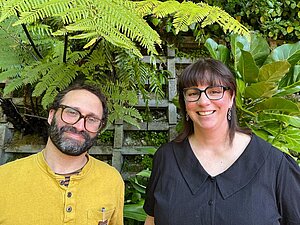
Lorena Gibson and Eli Elinoff ‘Commoning Ethnography’
with hosts Dr. Monica Mottin and Diego Jaimes-Niño
In this episode of the of our podcast, HaP team members Dr. Monica Mottin, research fellow for HaP in the Heidelberg Center for Transcultural Studies, and Diego Jaimes-Niño, project coordinator, spoke with Dr. Lorena Gibson and Dr. Eli Elinoff about their experiments in their journal, "Commoning Ethnography". They took us through the politics of commoning and how—from a research topic—it emerged as a methodology. Dr. Gibson and Dr. Elinoff share their experiences as the editors of the journal and the challenges of its publication, reflecting more largely about ethnographic practice, particularly in Aotearoa. Can ethnography be a site, source or scene of commoning? What new possibilities emerge when we combine commoning and ethnography? What is the importance of considering hope as a researcher? And why dedicate a journal to such a seemingly paradoxical experiment? We explore these questions through Lorena and Eli's experiences as editors and through their own research.
Dr. Lorena Gibson is a Senior Lecturer in the Cultural Anthropology Programme at Te Herenga Waka – Victoria University of Wellington. Her research interests include NGOs, international development, education, critical pedagogy, music, and hope.
Dr. Eli Elinoff is a Senior Lecturer in the Cultural Anthropology Programme at Te Herenga Waka – Victoria University of Wellington. His research explores the intersection between politics, urbanization, and environmental transformation in Southeast Asia. Listen to the episode here.
Newa women as public pedagogues fostering gender-inclusive placemaking in music heritage; a case study of Taḥnani Dāphā Khalaḥ - 28.08.2025
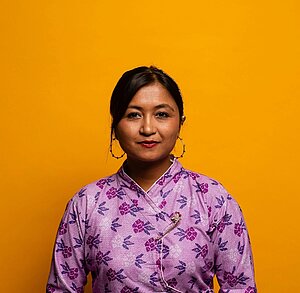
Pushpa Palanchoke
with host Christiane Brosius
In this podcast Pushpa Palanchoke spoke with Dr. Christiane Brosius, HaP Principal Investigator, about her work and ongoing doctoral research on gender, inclusivity, music and placemaking. Palanchoke discussed her work with different organisations such as Folk Lok and Taḥnani Dāphā Khalaḥ, which work with Dapha music, a musical form of the Newa community. She highlights the central roles these women play as educative agents and public pedagogues to foster gender-inclusive placemaking within the music heritage practices of the Newa people.
Pushpa Palanchoke is an Applied Ethnomusicologist and a Music Educator from Nepal. She is currently a doctoral candidate at Mutri Doctoral School, Sibelius Academy, Helsinki and a researcher at amplifyHer project. She is a recipient of Nepal Chatra Vidya Padak and Nepal Vidhya Bhusan (Ga) & (Kha), three highly prestigious national awards in the field of education. She is an academician with interests in gender-inclusive placemaking, rituals, music heritages and sustainability of and through them. She is also an artist—a vocalist and spoken word poet whose stage performance is a blend of melodies she has learned from different indigenous masters, and poetry that tells stories of nature, divine mother, human desires and struggles. She is the mind and heart behind the program Folk Lok. Folk Lok is a community-based arts program focused on the revitalization of indigenous music practices. Between 2020-2023, Folk Lok was supported by the U.S. Embassy’s Book Bus and managed under Satori Centre for the Arts. Listen to the episode here.
Fighting for streets and ponds: Everyday heritage in times of urban transformation - 25.09.2025
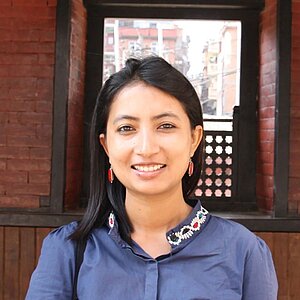
Sabina Tandukar
with host Christiane Brosius
In this episode of the HaP podcast, and within the Commoning strand, conservation architect and urban designer Sabina Tandukar reflected on her work preserving Kathmandu Valley’s living heritage—from ponds to historic streets and phalchaas (traditional rest houses) that serve as community lifelines. Speaking with Dr. Christiane Brosius, Tandukar shared her experiences fighting against neglect and top-down development pressures, emphasizing dialogue, collaboration, and the role of younger generations in reimagining heritage as part of everyday life. Through the case study of a street stretch in Sunaguthi, Tandukar highlightes how this was a moment in people’s solidarity in heritage preservation. She notes how people came together to resist street widening projects and to also make the street vehicle free during festivals. Further in her second case Tandukar highlights how reviving water bodies like Nigu Pukhu and protecting communal spaces not only safeguard history but also foster sustainability, social bonding, and a renewed sense of belonging in rapidly urbanizing Nepal.
Sabina Tandukar is a conservation architect and urban designer based in Kathmandu, Nepal, her projects span between monument conservation and urban conservation where she works with local residents and stakeholders as well as municipal institutions to think about and preserve local heritage for the present context. Listen to the episode here.
Queer heritage-making as a counterhegemonic strategy in Nepal - 30.09.2025
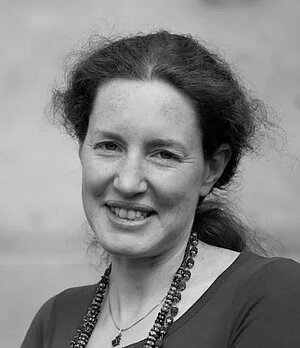
Marion Wettstein
with host Christiane Brosius
In this episode part of HaP's Commoning strand, Dr. Marion Wettstein spoke with Dr. Christiane Brosius, a Principal Investigator of the Heritage as Placemaking project at Heidelberg Centre for Transcultural Studies. Dr. Wettstein discusses the importance of queer heritage making in times of political turmoil. She gives us a glimpse into queer heritage making as a highly dynamic social process that is currently negotiated in Nepal between different groupings of the queer community as to whether to employ local cultural heritage as a counterhegemonic strategy or not. She spoke about the importance of intangible heritage in identity making and discusses the contestations that come up when a political march like the pride parade is taken out at the same time as a traditional Newari festival like Gai-Jatra. The conversation highlights how different queer organisations and NGOs negotiate and tussle with the appropriation of cultural heritage as a counter hegemonic strategy, arguing however that this lens is an important one to use in the field of culture heritage for it complicates the dominant trajectories and binary oppositions that are common to the academic field.
Dr. Marion Wettstein is an anthropologist, ethnographer, scientist of religion and curator with a comparative approach to religious, performative and material practices between Asia and Europe. In her current research project, Queer Heritage Making in Times of Political Turmoil: A transcultural approach, she studies vernacular approaches to cultural heritage and local traditions in Nepal. This project is a research tandem of the Flagship Initiative Transforming Cultural Heritage, at Heidelberg University. Listen to the episode here.
Itumbaha Museum: Challenges and opportunities of community museums in Living Heritage Sites - 30.10.2025
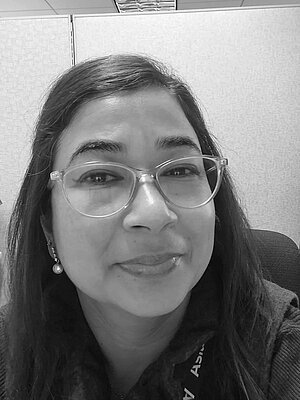
Swosti Rajbhandari-Kayastha
with hosts Diego Jaimes-Niño and Tara Brahme
In this episode of HaP's podcast, as part of the "Commoning" Series, Swosti Rajbhandari-Kayastha, curator, museologist and scholar from Kathmandu, Nepal, spoke with HaP project coordinator Diego Jaimes-Niño and student assistant Tara Brahme, about creating the Itumbaha Museum, a community initiative within a living heritage site in Kathmandu. Swosti discussed how a diversity of stakeholders came together to realise the project of adding a small museum to one of the oldest Newah Buddhist Monasteries in Kathmandu. During the process, balancing museographic exercise with the living heritage practices of the place came as a challenge, leading to processes of (un)learning and collaborative work, which also implied reflections from Swosti on the nature and methods of museographic practice itself. The layered meanings of "community" in the making of the museum are explored through the action of different stakeholders, including young students and stewards of the place, international organisations and self-denominated "activists" who opposed the museum's creation in its start. The project is revealed as the product of negotiations and socialities of those involved in its creation.
Swosti Rajbhandari Kayastha is a scholar of Nepali cultural heritage. She is a Fulbright Visiting Scholar (2024-25) in the Asian Art Museum, San Francisco, a board member of the Patan Museum and a senate member of Lumbini Buddhist University. Listen to the episode here.


 Datenschutz Impressum