Christiane Brosius
Prof. Dr. Christiane Brosius, Professor of Visual and Media Anthropology at the Heidelberg Centre for Transcultural Studies and Principal Investigator of the Heritage as Placemaking (HaP) research group, investigates heritage activism and reconstruction contestations surrounding ritual water architecture (hiti) and semi-public arcaded resthouses (phalcā).
Heritage Infrastructures as Urban and Sacred Placemaking: The Multifunctional Role of Arcaded Platforms (phalcā) in Patan, Nepal
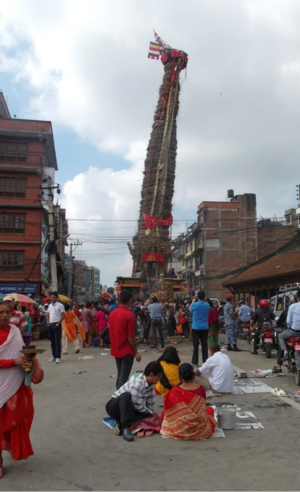
Urban transformation is commonly framed through the lenses of infrastructure development, economic growth, and spatial optimization. Within this paradigm, religious practices and structures are frequently perceived as obstacles to modernization, particularly when they occupy central urban spaces or disrupt circulation and land-use logics. This case study conducted within the framework of the Heritage as Placemaking research group challenges such assumptions by examining the jātrā of the deity Buṅgadyaḥ (also known as Rāto Matsyendranātha and Avalokiteśvara/Karuṇāmaya) as a dynamic and productive force in the making of urban public space. Rather than treating ritual as a residual or conservative element, the study conceptualizes the procession as an active form of placemaking that shapes urban rhythms, social relations, and spatial imaginaries.

The project investigates how the Buṅgadyaḥ Jātrā is embedded within a broader assemblage of material (tangible) and immaterial (intangible) heritage infrastructures that guide, sustain, and transform the procession. These infrastructures include not only streets and squares but also smaller-scale vernacular structures that play a decisive role in organizing movement, gathering, and social interaction. By foregrounding these often-overlooked elements, the project demonstrates how religious practices and urban transformation are mutually constitutive rather than antagonistic.
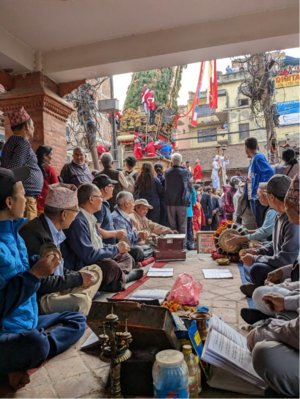
A central analytical focus is placed on the semi-arcaded platform known as the phalcā (New.) or pāṭī (Nep.). Despite its ubiquity in Newar settlements, the phalcā has received surprisingly little scholarly attention and is frequently overshadowed by monumental temples and palace complexes. Often dismissed as “ordinary,” the phalcā is nevertheless a crucial form of vernacular heritage that mediates between private and public space, ritual performance, and political negotiation. In the aftermath of the 2015 Gorkha earthquakes, phalcās have become especially salient sites where questions of reconstruction, heritage value, and everyday use intersect. As such, they offer a unique entry point into broader debates on resilience, continuity, and social transformation in urban Nepal.
The project advances a core thesis: processions such as the Buṅgadyaḥ Jātrā should not be understood as linear movements through neutral or pre-existing urban space. Prevailing scholarship tends to conceptualize space as a passive container through which ritual unfolds. This study proposes instead to understand jātrās as part of a multilayered “heritage infrastructure” composed of dense and socially charged nodes, or “heritage hubs,” connected in a web-like configuration. Phalcās emerge as key hubs within this infrastructure. They are not merely points of rest along the procession route but sites of performance, memory-making, discussion, and contestation. At these locations, diverse social agents negotiate what the procession should be, how it relates to past practices, and how it might adapt to changing urban conditions.
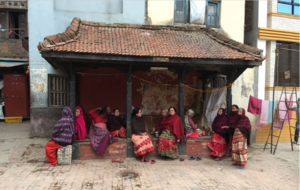
By conceptualizing phalcās as central hubs within a living heritage infrastructure, the project highlights their role in channeling mobilities, structuring encounters, and enabling the ongoing reinterpretation of tradition. “Tradition” is thus approached not as a fixed inheritance but as an active process of emplacement—an ongoing translation of “the Past” into present and future urban life. The project argues that such flexible, everyday spatial forms contribute significantly to the robustness of heritage practices, allowing the “old” to persist within and actively constitute the “new.”
Methodologically, the project combines spatial analysis, archival research, and ethnographically informed interpretation. It draws extensively on material collected through the Nepal Heritage Documentation Project (NHDP), including maps, photographs, and documentation of several hundred phalcās archived in the open-access Database and Digital Archive for Nepalese Art and Monuments (DANAM). By integrating this rich empirical material with theoretical debates on placemaking, heritage, and urban transformation, the project has produced both scholarly publications and publicly accessible research outputs.
Publications:
Brosius, Christiane. Forthc. “Heritage Infrastructures as Urban and Sacred Placemaking: The Multifunctional Role of Arcaded Platforms (phalcā) in Patan, Nepal.” In Manik Bajracharya, Christiane Brosius, Simon Cubelic, Rajan Khatiwoda (eds.). Buṅgadyaḥ: The Rain-Making God. Multidisplinary approaches to heritage as placemaking (working title), Heidelberg University Press (Documenta Nepalica Series), open and free acces
Public transfer:
Exhibition Buṅgadyaḥ: The Rain-Making God, at University Library Heidelberg (CATS branch), 1.10.-24.11.2025


 Privacy Imprint