

Procession Walks
Selection of curated walks to bring close the relation between intangible and tangible heritage.
Buṅgadyaḥ Procession in Patan
A heritage walk curated by Christiane Brosius and Monalisa Maharjan (2021)
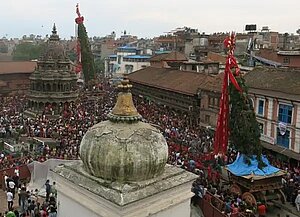
The chariot procession (rathayātrā) of Buṅgadyaḥ is one of the most important ritual events in the Kathmandu Valley, performed to invoke rain and agricultural prosperity. Beginning in Pulchok near the Aśoka Stūpa of Patan, the large wooden chariot is pulled through the historic city before reaching Jawlakhel, where the jewelled vest (bhoṭo) of the deity is displayed. The route map and detailed information on this page highlight the key stopping points of the procession and the major monuments located along the ceremonial path.
Exhibition on Buṅgadyaḥ: The Rain-Making God
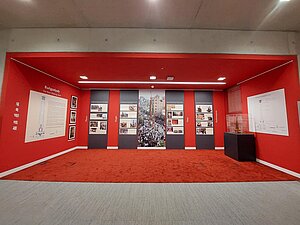
On October 1, 2025, the University Library Heidelberg (CATS branch) opened an exhibition focusing on the Buṅgadyaḥ (Rāto Matsyendranātha) procession in Patan, Nepal. The exhibition was also connected to the opening of the European Conference for South Asia Studies (ECSAS), which was held in Heidelberg from 1 to 4 October 2025. Recognized as one of the Nepal’s most significant festivals, the procession is documented in the exhibition through less-known materials and perspectives from the Nepal Heritage Documentation Project (NHDP), including historical photographs by Bruce Owens images, maps, fieldwork photographs, film footage, and records from NHDP-curated heritage walks. A short film produced by the NHDP team accompanies the exhibition and will be made available as open access after the exhibition period. The exhibition runs until October 31, 2025, and is accessible during the library’s regular opening hours. It was assembled and conceptualized by Christiane Brosius, Marion Wettstein, Manik Bajracharya, Simon Cubelic, Rajan Khatiwoda and Monalisa Maharjan.
Video on the Buṅgadyaḥ (Rāto Matsyendranātha) procession
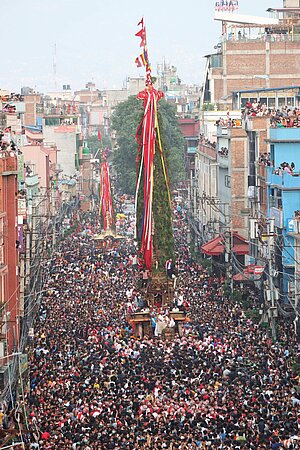
This short film was created to accompany the exhibition on the Buṅgadyaḥ (Rāto Matsyendranātha) procession held at the Heidelberg University Library (CATS branch). The exhibition was organized in conjunction with the 28th European Conference on South Asian Studies, convened in Heidelberg, Germany, from 1–4 October 2025, and remained open to visitors from 1 October to 25 November 2025.
Produced by the Nepal Heritage Documentation Project (NHDP) with the support of the Arcadia Fund, the film offers a concise introduction to one of Nepal’s most revered ritual traditions—widely regarded as the longest-running chariot procession in South Asia—dedicated to the deity Buṅgadyaḥ.
Buṅgadyah, the “deity of Buṅga (Buṅgamati)” (see DANAM id: LAL0001), is a syncretic divinity venerated by both Buddhists and Hindus across the Kathmandu Valley. Nepalese genealogical traditions trace the origin of the Buṅgadyaḥ procession to the Licchavi king Narendra Deva in the seventh century, associating it with a legendary drought and the deity’s arrival from Kāmarūpa (present-day Assam). Yet these narratives present divergent chronologies and lack firm contemporary epigraphic corroboration. Historically verifiable references to Buṅgadyah emerge only in the early medieval period, when he appears in Buddhist contexts as Avalokiteśvara (Padmapāṇi/Lokeśvara) and in Hindu traditions as Matsyendranātha. By the thirteenth and fourteenth centuries, Buṅgadyaḥ had risen to prominence as a pan-regional deity of the Nepal Maṇḍala, with an elaborate chariot festival sustained through royal patronage, guthi institutions, and broad civic participation throughout the Valley.
Kirtipur: a city woven into music
Curated by Pushpa Palanchoke (2022), with support by Bharat Maharjan
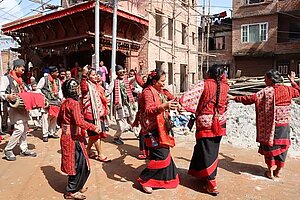
The Newar community of the historic town of Kirtipur celebrates different festivals throughout the year. On particular days, phalcās, one or two storied arcaded rest houses, become a spot to gather for more than just everyday conversations. These gathering places and the activities in and around them are meaningful for musical practices and practitioners. Charged with energy, music performances in phalcās transcend time and space.
This heritage walk will invite you to glimpse into the world of rituals that make these gatherings special. To do so, the walk will provide a specific lens by refering to a special traditional social institution: the music groups (Dāphā Khalaḥs) of Kirtipur. Dāphā is a special music genre common to Newar communities of and around Kathmandu Valley. Dāphā songs are sung from old hand-written text books called saphū. They are composed in a specific rāga (melodic feature, mood) and composed in particular tāla (metric cycle).
Usually, the music group, Dāphā Khalaḥ, occupy a neighbourhood's phalcā in weekly (sometimes even daily) singing sessions during specific religious months during special hours of the day. Mostly, these sessions take place early in the morning or in the evenings. There are arcaded rest houses (phalcā) that have been built especially for the music performances. With the songs, the group praises the protecting deities and connects the gods to the community and places. Besides paying devotion to the deities through musical performance in the phalcā, a local community also gains religious merit by organizing annual pilgrimages and rituals. These events can be both sacred and secular in nature. Music, masks, dance, procession, traditional costumes and feasts are primary features of these rituals and often engage old and young, women and men.
The heritage walk will take you around the historic city of Kirtipur and visit those phalcās relevant for the selected music and festivals of the locality. Although some of the rest houses we visit have been rebuilt recently, often in connection to their demolition during the Gorkha earthquakes of 2015, the music, lyrics and rituals tell a story that underlines the long and dynamic past of the built heritage. The sites speak of the history of Kirtipur, about the city’s transformation, a transformation that has been particularly visible since the 2000s. We have included sound in the walk: As you walk offline or online you can choose to listen to a poem from the 12th century, called Śrita Kamalā, written by Sanskrit Poet Jaydeva. The voice that you will hear one of the first women apprentices of Taḥnani Dāphā Khalaḥ who were initiated into the tradition of Dāphā in 2021. Already this detail shows the dynamics of tangible and intangible heritage: until recently, it was not possible for a woman to envisage and practice apprenticeship and initiation into a music group.
Following the Buddha – The Phudyaḥ (Dīpaṅkara) Yātrā of the Pañcadāna Festival in Patan
Curated by Christiane Brosius and Nutan Sharma (2020/21 CE)
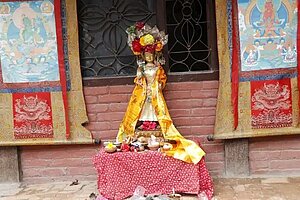
The Dīpaṅkara Buddha, or ‘Maker of Light’, is said to predate the historical Gautama Buddha, and is often equated with the first Buddha. Pañcadāna (lit. ‘five offerings’) is a festival in which the initiated Śākya and Vajrācārya males have to manifest their monastic status by going from house to house to collect alms from at least seven houses. In the historic city of Patan, this festival is known as Yala (Patan) Pañcadāna. It is celebrated on the 8th lunar day of the bright fortnight of the Śrāvaṇa month according to the lunar calendar; in 2020, that day fell on July 28.
On the day of Pañcadāna, initiated male lay devotees offer alms to the Vajrācārya priests and Śākya householder monks. Of central importance is Phudyaḥ – a approximately 60 cm high gold-plated copper icon of the Dīpaṅkara Buddha. The icon of the deity is carried from house to house, and from monastery to monastery, by the Śākyas of the Ukubahāḥ monastery. When the deity visits the selected places, it is worshipped with gifts (dāna). Offerings are mainly rice grains, wheat grains, salt, fruits, money and the likes.
The Phudyaḥ Yātrā continues from morning until late evening. The icon of Phudyaḥ, usually kept in the Ukubāhāḥ monastery, is cleaned one day before and on the next day, in the morning on the very day of the procession, it is displayed in the northern wing of the monastery with its ornaments and full decorations. At that time, local residents, mainly Śākyas of the locality, come to offer their pūjā and alms to the deity. After that the yātrā begins its traditional route.
The route can be divided into two parts. The first circumambulation with 10 stops starts and ends in Ukubāhāḥ in the morning. Even upon returning to its home monastery, the icon of the deity does not enter the vihāra. It remains outside while participants are allowed to enter the monastery to have their lunch1. The second circumambulation with 15 stops – from noon to evening – takes a different route 2
1. This part seems to be dedicated to the Guitanakiṃ with whom the Dipaṅkara Buddha accepted the first dāna according to the above-mentioned legend. ↩
2. This part seems to be dedicated to the King Sarvānanda of the legend with whom the Dipaṅkara Buddha accepted the second dāna, as this second route of the jātrā goes through the royal palace of Patan.↩
Michaels, Axel. “From Syncretism to Transculturality: The Dīpaṅkara Procession in the Kathmandu Valley.” In South Asian Festivals on the Move, edited by Ute Hüsken and Axel Michaels, 317–42. Wiesbaden: Harrassowitz, 2013..


 Privacy Imprint